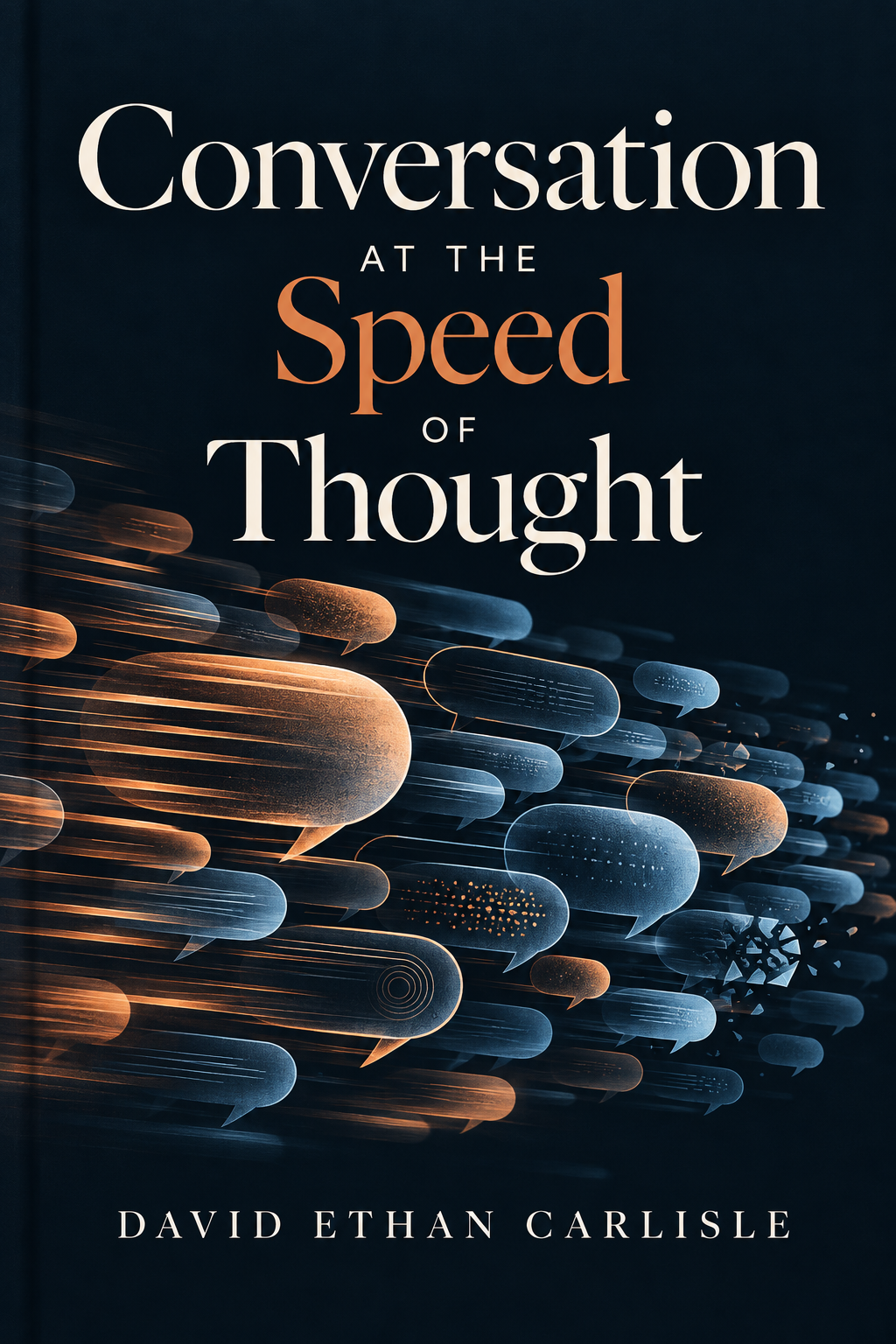
Prologue: Conversation at the Speed of Thought
When Meaning Cannot Keep Up
What happens when conversation moves faster than comprehension?
We are living the answer.
Updates arrive in an instant. Reactions come in a split second. And somewhere in between, we are losing the ability to take in meaning as it happens.
Decades ago, Neil Postman and Marshall McLuhan saw this coming.
Postman spoke of a “vast and trembling shift from the magic of writing to the magic of electronics.” He watched the slow habits of print, the habits that once held public thought together, begin to dissolve.
McLuhan told us that “the medium is the message.” The shape of how we speak decides what we can say.
But the medium has raced so far ahead that our messages fall apart before we can grasp them.
Our world is built to shred attention into confetti. This is not mere distraction. It is the steady collapse of sustained focus, built by people who profit from the fall.
We scroll, and scroll, and scroll. We take in everything and digest nothing. And dialogue dissolves into noise.
Postman warned that when “a people become an audience and their public business a vaudeville act,” a culture can die.
We are standing at that edge.
The stakes could not be higher. If we cannot slow down long enough to take in what we hear, if we cannot hold an experience longer than a headline, then real connection and a shared reality slip out of reach.
What you cannot metabolize, you cannot understand.
Meaning is combusting on reentry.
Every ping. Every alert. Every breaking-news banner. Every viral trend. Each one adds heat and friction, and nuance burns away before it can land.
We live in a relentless now. Context collapses. Every statement is stripped bare and asked to stand alone, without the frame of what came before it.
This is more than overload. It is a mismatch between how fast messages move and how fast people can absorb them.
The mind works in layers. It needs time to link the new to the known. And that slow, human work cannot keep pace with the feed.
This book calls it containment failure: a space too small and too fast to hold what we are trying to say.
In a space like that, misunderstanding is not an accident.
It is the system working as built.
The Algorithmic Authority
Into this chaos steps a new authority.
The algorithm.
It has no face. No title. No office you can call.
Every second, it decides whose voice is heard and whose voice fades away. And it decides by one measure alone: what keeps you scrolling.
The shocking rises. The angry rises. The easy rises.
The careful sinks. The complex sinks. Anything that asks for more than a moment sinks without a sound.
No one has to ban a thoughtful argument. It simply never reaches anyone.
This is censorship without a censor. No one is silenced. They are just never shown.
In Filterworld, Kyle Chayka shows how this machinery flattens culture toward the familiar. It rewards whatever looks like what worked before, and it punishes what is new, or deep, or slow.
Meaning is sacrificed at the altar of virality.
And make no mistake about who built that altar.
The companies behind these platforms chose to rank our conversations by engagement. They profit from every minute that choice captures. Researchers at the Knight First Amendment Institute have documented the result: feeds that amplify anger and division. Outrage holds attention, and attention is what they sell.
This is not an accident. It is a design feature.
The public square did not decay on its own. It was engineered into an arena.
And we are being trained by it.
Every like is a reward. Every silence is a correction. Post the careful thought, and hear nothing. Post the provocation, and watch it spread.
Over time, we learn to speak in ways that create friction instead of understanding.
Here, truth does not win. The loudest version wins. The most extreme version wins. The version easiest to swallow wins.
The same machine now decides what looks credible.
A source on the first page of search results feels trustworthy because it is there, not because it has earned our trust. Rank has replaced reliability.
This is algorithmic credibility, not substantive credibility. And we are losing the ability to tell them apart.
Visual First, Thought Last
Then came the screens built for watching, not reading.
Instagram. TikTok. YouTube.
Images and video hold attention longer than words, so the platforms push them, and visual content now rules the conversation.
We are being rewired to favor spectacle over substance.
If an idea does not strike the eye, it is ignored. Charisma beats clarity. Quick cuts beat careful thought. Surface beats depth.
An argument that once filled an essay must now fit inside a thirty-second reel. Its context is cut. Its reasoning is cut. What remains is a fragment, sent out into the world to be misread.
Whole stories are broken into pieces.
This is narrative sabotage. And as we will see, it is not a flaw in the system.
It is a feature.
But this is not a eulogy for conversation.
It is a battle plan for its rebirth.
The chapters ahead will show how we can compress ideas without crushing them, protect emotion, restore context, and carry real dialogue through a fast and visual world.
The message is urgent, but it is hopeful. We can save the future of meaning, but only if we redesign the way we speak, and the way we listen.
What follows is nothing less than a survival plan for the most sacred thing the human mind can do.
Genuine conversation.
So are we ready to speak, and to listen, at the speed of thought?
The survival of our culture’s soul may depend on it.
Sources
Neil Postman, Amusing Ourselves to Death
Marshall McLuhan, Understanding Media
Kyle Chayka, Filterworld
Knight First Amendment Institute, research on engagement algorithms (2023)
The Medium Is the Prison
Marshall McLuhan told us that “the medium is the message.”
In the 1960s, he saw that every new medium, from print to television, reshapes how we think and what we value. Often more than anything it carries.
Decades later, Neil Postman watched television turn public discourse into entertainment. Politics became a show. Religion became a show. He saw a culture where “cosmetics has replaced ideology.”
They were prophets. But even McLuhan and Postman could not have imagined the 2020s.
Their world had newspapers and broadcast towers.
Ours has algorithmic attention markets, machine-made content, and one-sided bonds with strangers stretched across the globe.
Today’s platforms do not just shape the message. We live inside them, and they shape us. They draw the walls around what we believe is legitimate, and what we believe is true.
The medium is no longer just the message.
The medium is the prison.
From “Medium Is the Message” to the Algorithmic Age
McLuhan dreamed of a global village, a world drawn close by technology.
That village has exploded into a planet of eight billion people, each one wired in, each one fed a stream built just for them.
McLuhan was right that the form of media would govern the form of society. But he lived before the feed. Before machines learned to curate us.
Today’s village is not a cozy town square. It is a roar, conducted by hidden systems that decide who sees what, and when.
We now live inside an attention economy. Our eyes are the prize. The algorithms are the auctioneers.
On Facebook, Instagram, and TikTok, vast machine-learning systems study our desires and our fears. Then they serve whatever will keep us scrolling. Endlessly.
The medium is no longer a channel. It is a living, adaptive environment, tuned by the companies that own it to hold us as long as possible.
McLuhan’s insight has never been more literal.
If the medium favors a thirty-second dance clip or a 280-character hot take, then that is what our cultural conversation becomes. The tempo of the format becomes the tempo of thought. The brevity of the format becomes the limit of thought.
Our attention has not simply worn thin. It was frayed by design.
Postman, writing in the 1980s, mourned what television did to culture. When the screen demands constant entertainment, truth and depth give way to spectacle.
He put it this way: “the medium is the metaphor.” Every medium teaches a way of thinking. Television taught us to see life as a string of amusing episodes.
He feared we would all become entertainers and consumers instead of thinkers. He was right. Politics turned to optics and charisma, just as he warned.
But today’s reality goes beyond his worst fears.
Television was a one-way broadcast. It changed how we received.
Today’s platforms run both ways, amplified by algorithms. They change how we take part.
Consider three things McLuhan and Postman never had to face.
Algorithmic control.
Television waited for us to tune in. Today’s media reaches out and arranges our reality for us.
The timeline on X. The For You page on TikTok. The news feed on Facebook. Each one is ranked by systems built to maximize engagement. That means they decide what is visible, and what counts.
The medium is no longer just shaping messages. It is choosing which messages count as reality at all.
If a fact does not engage, it is not shown. And what is never shown, in the public mind, never happened.
McLuhan’s global village now has a hidden mayor. And no one elected it.
Machine-made content.
In Postman’s day, people at least made the content. Now machines write text, fake video, and clone voices at scale.
The flood has outrun any human editor. It is harder every day to trust what we see and hear, and doubt hangs in the air like smoke.
McLuhan said the medium extends us. Today, it often deceives us. It speaks on our behalf, in voices we cannot tell from our own, and the line between truth and simulation wears away.
Parasocial saturation.
People have always felt close to the faces on their screens. A favorite actor. A beloved character.
But now those one-sided bonds are a way of life. We follow influencers, YouTubers, Twitch streamers, even CEOs and politicians tweeting from the toilet. We feel close to dozens of people who will never know our names.
Our emotional energy pours into friendships that are not friendships at all.
We know more about the private lives of strangers online than about the neighbors next door. We feel surrounded by relationships, yet few of them are real, and fewer still are returned.
Postman could not have pictured thousands of people grieving or celebrating a vlogger’s latest update.
But here we are.
McLuhan and Postman gave us the words to see that media shape culture. But their frameworks now strain under the press of the present.
Today’s media is more immersive, more personal, and more manipulative than anything they foresaw.
So what becomes of McLuhan’s message when the medium is a gamified attention casino, curated by machines?
What becomes of Postman’s discourse when every person carries a broadcast channel in their pocket, tuned for maximum emotional impact?
To answer, we have to face the deeper shift.
Modern platforms are not passive channels that carry meaning.
They are active filters that decide it.
They are the judges of legitimacy and belief.
And they are training us to accept only certain speeds, certain feelings, and certain voices of authority.
Platforms as Filters of Tempo, Emotion, and Authority
Let’s make this concrete.
TikTok. X. Slack. Zoom.
These platforms do more than shape our messages. They set the conditions under which any message can be made, and heard.
Each one has its own rules. Each one teaches a hidden curriculum. And each one grades us on three things: how fast we move, what we feel, and whom we trust.
TikTok.
TikTok is a stream of short videos, flicking past at lightning speed.
No one forces you to dance or chase a meme. But if you don’t, you will likely be ignored.
The platform sets the tempo, and it shows no mercy. To take part, you match its speed. Complex ideas get crushed into catchy soundbites. A subtle message rarely survives when the viewer can swipe it away in a second.
The algorithm also teaches us which feelings are allowed.
Big feelings win. Outrage. Awe. Tearful confessions, packaged in a trending sound.
Lukewarm sincerity loses. Quiet nuance loses. Subdued, complicated emotions are filtered out as boring.
And TikTok crowns its own authorities.
A teenager with slick editing and five million followers can seem more credible than an expert with five hundred. Charisma and visual flair become the marks of authority.
The medium chooses its experts by virality, not by knowledge.
X.
X, once Twitter, was called the public square of the internet.
In theory, anyone can speak. In practice, the platform rules the conversation through character limits and trending algorithms.
The tempo is rapid fire. If you don’t jump on the news within the hour, your insight might as well not exist.
Wit and aggression fit the format. Long reflection does not.
The emotional rules reward snark, outrage, and bursts of euphoria that fade by morning. X does not ban empathy. It does not ban careful thought. But its structure, the public likes, the instant reposts, the trending tags, quietly makes deep compassion and measured debate almost invisible.
And authority? It is a strange mix of verified badges, follower counts, and meme fluency. Your standing often has less to do with who you are in real life, and more to do with how the crowd has scored you.
The medium decides that quick, loud voices carry farther than quiet, careful ones.
Slack.
At work, Slack has become the nervous system of the organization.
Its endless channels demand constant availability. If you don’t answer within minutes, you risk looking disengaged.
Complex discussions splinter into rapid threads, and the fastest typist often steers the outcome.
The emotional rules lean upbeat, even performatively so. Emojis and exclamation points prove you are a team player. Confusion or dissent can feel unwelcome, because it breaks the mood of quick agreement.
Authority bends here too. Influence comes less from title or expertise, and more from who can grab the channel’s attention. One clever quip or one quick link can grant outsized sway, while slower, deeper voices drown in the scroll.
Zoom.
Then there is Zoom, our stand-in for sitting face to face.
The medium is a grid of faces, with the mute button never far away.
It sets the tempo through scheduled slots and the quiet pressure to fill every silence. Pauses must be short, or someone will ask, “Can you still hear me?”
The emotional rules swing to extremes. Either perform cheerful attention, smiling and nodding to signal that you are engaged, or risk looking checked out. A moment of honest reflection reads as absence when your face sits still on the screen.
And authority goes to whomever the interface lifts up. A bright frame lights up around the person speaking. The one who shares the screen controls the story.
Zoom can flatten hierarchy, putting everyone in an identical box. But it builds new hierarchies too: who talks the most, who has the best light, who has the loudest mic.
The technology now sets the rhythm and the tone of human exchange.
Across every platform, the pattern is the same.
The design of the medium sets the standards for speed, for feeling, and for credibility.
These standards were not handed down by nature. They were written into the software by the companies that own it.
We adapt by instinct, often without noticing. We learn what plays well, and we trim ourselves to fit.
And in doing so, we hand these platforms the power to filter our reality.
The medium becomes the gatekeeper of legitimacy. Only ideas that fit the format and the feed make it through.
So ask yourself: is a thoughtful idea real if it never trends? If it is never boosted, never shown, never seen?
More and more, if it does not exist on the platform, it does not exist at all.
And the platform’s biases become our society’s biases about what is true, what matters, and what deserves our attention.
The Invisible Prison of Media Platforms
Media has become an invisible prison.
Not a cell of concrete and steel. A prison of incentives. Of rewards and punishments, built into the platforms we use every day.
We are confined by what the medium rewards, and by what it punishes.
The walls are made of dopamine-driven design and algorithmic feedback loops. The bars are made of our own hunger to be seen and approved.
And inside this prison, we perform willingly, often without noticing that our freedom has been taken.
What does this prison look like?
It looks like a system of rewards and punishments that steers what we do.
Speed is rewarded. Deliberation is punished.
In this prison, faster is always better.
The news never sleeps. The feed never stops. And the first loud opinion often wins, whether it is right or not.
Post the instant reaction, ride the wave of the trend, and the likes pour in. Post a careful analysis a week later, and you hear crickets.
This hunger for speed locks us in the now. There is no time for context. No time for hindsight.
Thoughtful deliberation feels like arriving late to a party that has already moved on.
What remains is a culture of knee-jerk takes and shallow agreement, where slow truth can never catch fast lies.
Flattery is rewarded. Honesty is dangerous.
Online, there is a saying: don’t read the comments.
Why? Because anyone who speaks an uncomfortable truth may be swarmed by trolls, or turned on by their own followers for bringing “negative vibes.”
The medium rewards flattery. Likes and praise flow to those who echo the tribe and confirm what the audience already believes.
So many learn to flatter. You’re so right. Here’s a post that praises your group. I won’t say anything that cuts against the crowd.
Meanwhile, honesty becomes a liability, especially unpopular honesty.
Whistleblowers, fact-checkers, and people who call out lies are often harassed by mobs, or pushed down the feed for being “controversial.”
The prison has wardens: the algorithm, and the mob it feeds. And the wardens prefer smooth engagement to uncomfortable truth.
So people silence themselves. They choose agreeable lies over divisive honesty.
Visual drama rules. Written depth suffocates.
As media turns to images and video, what dazzles the eye beats what feeds the mind.
In this prison, looking good is half the battle.
Instagram taught us that a picture is worth a thousand words. And perhaps that a thousand words without a picture are worth almost nothing.
Complex arguments and hard data get flattened into infographics and five-second clips. If it doesn’t catch the eye, it scrolls into oblivion.
So every important issue must become entertainment just to be noticed. We get infotainment. Edutainment. Everything colorful, everything simplified, often to the point of confusion. And the confusion comes beautifully packaged.
Style beats substance. The result is a kind of high-definition ignorance. People feel informed because they watched a slick video, while the real complexity is lost.
The inmates come to prefer a pleasing illusion to an ugly reality.
Performance is rewarded. Authenticity is punished.
Here lies the cruelest irony of all. The prison turns our emotions and our identities into weapons.
We have learned that outrage brings clicks. That a polished personal brand earns trust. That a touch of staged vulnerability, the tearful apology video, the humblebrag, can lift engagement.
Feelings become tools, used to win arguments and grow audiences. Watch an outrage cycle on X raise an army of reposts. Watch a YouTuber cry on camera for sympathy.
When feeling becomes a weapon, there is little room left for feeling that is spontaneous, or quiet, or complicated.
At the same time, a consistent persona, on brand and on message, is rewarded with followers and status. Real human complexity is punished.
Show a contradiction, or change your mind in public, and you are branded a hypocrite.
Reveal a weakness that doesn’t fit your image, and you lose face.
The medium demands that you be consistent, simple, and marketable.
In effect, it asks you to be an actor playing yourself.
And many of us agree, knowingly or not, curating our lives to fit the platform.
Together, these forces form the silent architecture of our prison.
The terrifying part is how natural it has come to feel.
We have taken the rules inside. A thought arises, and we sense at once whether it is a clever post or a minefield. We hold back a sincere reflection on LinkedIn because it is not on brand. We rush to comment on the latest crisis, because silence feels like vanishing.
The medium’s biases start to feel like our own preferences.
We tell ourselves we must be fast, responsive, always on, just to stay relevant.
We forget that this is exactly what the platforms trained us to believe.
And they trained us that way because it pays.
The result is two linked failures: narrative sabotage and attention collapse.
Any attempt to build a coherent, thoughtful story online is undercut almost at once. Sabotaged by the next distraction. The next outrage. The next shiny thing in the feed.
It is hard to finish any idea when the medium never stops interrupting. The story shatters into trending fragments.
Meanwhile, our shared attention has collapsed. It is nearly impossible to hold the public’s focus on any problem long enough to solve it.
We scroll from crisis to crisis, trend to trend, with no resolution in sight.
Confusion itself has been made beautiful. We are so used to contradictions dressed in glossy formats that we accept confusion as the normal state of things.
And beneath it all, emotion is weaponized at scale. Every feeling is amplified, politicized, or sold, until it is hard to tell a real human response from a performance.
This is the mental and emotional landscape of the prison we live in.
When Nuance Becomes a Liability
Perhaps the most tragic thing this prison does is what it does to thoughtful people.
In a healthy conversation, the ones who hesitate, who reflect, who weigh the complexity, would be our voices of reason.
Here, those same people are misread. As weak. As vague. As simply too slow.
The medium punishes nuance, contradiction, and reflection so harshly that many thoughtful voices have been silenced, or pushed to the side.
Think about how nuance fares on X.
Admit uncertainty, or explore both sides of an issue, and you will likely be met with confusion or scorn.
What’s your take? Are you with us or against us?
The timeline has no patience for “on the other hand.” No patience for “it depends.” It demands instant clarity, even false clarity, delivered with snappy conviction.
In that format, the nuanced thinker looks indecisive. Their careful words are read as evasion.
Meanwhile, the brash slogan spreads like wildfire.
So many experts and careful speakers simply give up, or they dumb themselves down. They learn that context and caveats do not survive a medium that prizes speed and punch over accuracy.
Here, the prison bars are the character limit and the herd instinct of virality.
Push against them with nuance, and you bounce off into oblivion.
And it is not only social media.
In a Zoom meeting, a thoughtful person pauses to think before speaking. But on Zoom, a few seconds of silence reads as awkward. Maybe even incompetent.
By the time the words are ready, the quick responders have moved on. The decision may already be made in the flurry of crosstalk.
When the thoughtful person finally speaks, it lands as an afterthought. Why didn’t they say something sooner?
In the language of this medium, timing is everything. Even more than content.
So the medium misreads thoughtfulness as a lack of confidence, or a lack of clarity.
We see it at work too, on Slack and in email.
Write a measured, detailed message while everyone else fires off one-liners, and you look wordy. Overcautious.
The culture of immediacy reads careful communication as out of touch. As not being a team player.
If you don’t pull the dopamine lever of the quick reply, you pay a social price.
Over time, thoughtful people make one of two choices.
They adapt, learning to simplify and send hasty messages against their better judgment.
Or they withdraw from the conversation, alienated and unheard.
Then there is the penalty for changing your mind.
Real thinking is full of contradiction, revision, and doubt. You say one thing today and refine it tomorrow, because you learned something.
But online, any shift becomes a gotcha. Old posts are dredged up to brand you a flip-flopper, or a fraud.
The medium never forgets, and it keeps a public scoreboard. Together, they make honest growth dangerous.
People grow afraid to think out loud. Afraid to change their minds. Because the medium offers no mercy, and no context.
The prison demands consistency, even when that consistency is only stubbornness, or ignorance.
So many nuanced voices silence themselves before anyone else can.
They watch the loudest opinion win, and they think: My view will only be twisted, or attacked.
In a very real sense, the medium is stripping a whole class of people of their voice.
The ones who thrive are the quick-draw artists. The simplifiers. The provocateurs.
The careful thinkers, the reflective skeptics, the ones who could bring depth and caution to our runaway conversations, are muted. Or their words are bent out of shape.
This is a tragedy for them. But it is a tragedy for all of us too.
We are losing the people who can walk through gray areas. Who can hold conflicting facts together. Who can say “I don’t know” when no one else will.
And we are left with a public square ruled by overconfident voices and simple stories, because those are the voices the filter lets through.
If you have ever felt misread or silenced because you refused to oversimplify, you are not alone.
It is not your fault. It is the medium’s bias.
This chapter is a diagnosis of that bias. But it is also a call to see that nuance is not a weakness.
It is a casualty of an environment hostile to depth.
We must remember that being quick is not the same as being right.
And loud is not the same as wise.
In the chapters ahead, we will look at how to win back room for nuance and complexity, in a world that has grown allergic to both.
The Human Cost of Performative Communication
Living and speaking inside this prison takes a toll.
There is an emotional cost, and a moral one, to bending yourself again and again to fit the medium’s demands.
When honesty, difference, and vulnerability are punished, what happens to the human soul?
The cost of constant performance.
Many of us now live on stage.
We shape our words, our tone, even our faces for each platform, as if writing press releases for a personal brand.
The pressure to always be on is immense. We act like celebrities managing our image, knowing that any slip could be recorded and broadcast.
One clumsy post. One unflattering photo. One honest but unpopular opinion. And the crowd may descend.
So we stay on script.
But wearing a mask day after day hollows us out.
You may gain followers. You may earn praise for how well you sell yourself. And still feel that almost no one knows the real you.
Because, if you are honest, you have not let the real you out in a long time.
The medium has trained you to trade your authentic self for a version that is easier to like, and easier to sell.
Over time, the gap between the self you perform and the self you are can breed depression. Impostor syndrome. A sense that you have lost who you are.
You become a prisoner of the persona you built.
The whiplash of public attention.
Human beings were not built to ride the highs and lows of public attention at this scale.
One moment, you are flying. Your post went viral. Praise pours in.
The next moment, the tide turns. Something you said didn’t land, and now a wave of criticism crashes over you. Or worse, a coordinated campaign of harassment.
This rollercoaster of praise and punishment is exhausting.
It trains us to chase the next high of approval, and to dread the next drop.
When feedback is this fast and this extreme, it becomes harder to steady our own emotions.
Our nervous systems are flooded with alerts and so-called news that demand a reaction but offer no resolution.
We live in constant adjustment, trying to please an audience we cannot predict.
And many of us carry a low hum of anxiety, always bracing for the next notification. Will it be a dopamine hit, or a gut punch?
The danger of being vulnerable.
Real vulnerability is what builds real connection. And on these platforms, it is especially dangerous.
Share a deep personal struggle on Facebook or X, and friends may rally around you.
But trolls may also turn your pain into a weapon. Strangers may miss your context entirely.
It is common to watch someone pour out their heart, only to be met by a swarm of unwanted advice, judgment, or mockery.
Sometimes a person’s most heartfelt post becomes the day’s laughing meme.
So people learn a protective cynicism. They become reluctant to share anything that isn’t polished.
Honest signals of need, or of difference, are punished. Sometimes with ridicule. Sometimes with silence, which can hurt just as much.
So people stick to safe subjects. They wear a mask of being okay. They move their real conversations into closed, private rooms.
And the public square grows ever more shallow.
The price of thinking differently.
Divergent thinking pays a toll too. Challenging the consensus. Offering an original view.
In a climate of groupthink, the person who says “I disagree” risks becoming an outcast, or a target.
Online mobs descend with alarming speed on anyone who strays from their community’s story.
Even at work, raising a red flag or an unusual idea can mark you as not a team player. The punishment is quiet. You stop getting invited to the meeting. You are left out of the thread.
So people learn to stay in their lane, emotionally and intellectually.
And the tragedy is what follows: a kind of learned helplessness. A slow slide into apathy.
Why bother thinking deeply? Why bother thinking differently? It only brings trouble.
So people disengage. Or they keep their true thoughts private while echoing whatever seems safe in public.
This self-censorship slowly wears away our integrity and our passion.
It hurts to care deeply about something and feel you can only say it behind closed doors.
Exhausted by communication itself.
All of this adds up to a deep emotional exhaustion.
When every exchange is a performance review by the crowd. When every opinion might spark a firestorm. When every honest word must be weighed against the risk of being twisted or attacked.
No wonder so many people feel burned out by communication itself.
Instead of connecting us, these platforms often leave us isolated and misunderstood.
We have more interaction than ever before, and less understanding.
The medium promised to bring us together at the speed of thought.
Instead, it has left many of us lonely at the speed of light.
The seed of change.
And yet, the human spirit is not broken.
Many of us can feel that something is wrong.
You may be reading this and nodding. Remembering the times you bit your tongue. The times you played along with a charade, and regretted it.
That awareness is the seed of change.
Yes, the medium has punished your honesty and drained your empathy. But the fact that you feel the loss means you still value what was lost.
That is what we build on.
The rest of this book is about how to take back our minds and our relationships from the medium’s biases.
But the first step is to see the prison for what it is.
Only then can we begin to escape it.
Modality Mixing: Rewriting the Rules of Engagement
How do we break out of a prison that surrounds us, yet cannot be seen?
The walls of this prison are made of one mode. Fast text. Endless video. A single dominant form that dictates all the terms.
The way to crack those walls is to break the medium’s expectations. To mix our modes. To change our pace in ways the algorithms, and the habits they built, do not expect.
This is not about clever hacks. It is not about gimmicks.
It is about survival. And it is about freedom.
To thrive, we must become fluent in many ways of speaking, and mix them on purpose, taking back control of tempo, tone, and meaning.
What mixing looks like.
Modality mixing means combining text, image, sound, and timing on purpose, to win back depth and agency.
At work, instead of firing off another reply in a fast Slack thread, you send a thoughtful voice note. Or a quick sketch that explains the hard point.
Suddenly, the rhythm changes. Your colleagues have to stop and listen for a minute. The cycle of knee-jerk replies is broken.
Online, instead of chasing every meme of the day on X, you write a longer post, or a newsletter. Old-school text, at a slower pace. Then you use X only to share the link, with a short, sharp summary.
You are mixing the fast with the slow. Using the quick platform to point people toward the slower place where nuance lives.
And in your personal life, when a text exchange with a friend starts to go wrong, you pick up the phone. Or you switch to video. You bring back the voice, the tone, the human presence that plain text was bending out of shape.
Telling the medium no.
This kind of mixing is a way of telling the medium: You do not get to decide how I say this.
If the platform favors images, bring words.
If it drowns in words, bring images.
If it never stops, impose a pause.
We take back power by surprising the system with a different mode, the way a prisoner finds the blind spot in the guard tower.
It forces others, and the algorithms too, to adjust. And it often reveals cracks in the medium’s supposed total control.
Look at how activists have learned to use many platforms at once. A hashtag campaign, fast and viral. A heartfelt video, slower and told as a story. A march in the street, embodied and shared in person. All for the same cause.
By mixing modes, the message becomes too alive to be easily captured or silenced by any one medium’s bias.
A strategy for staying human.
In the chapters ahead, we will explore modality mixing as a form of resistance.
We will see how varied channels and forms can restore balance between speed and reflection. Between performance and authenticity.
This is not multitasking. It is not a tech trick.
It is a deliberate strategy to stay human in a digital world that would flatten us into copies.
By changing our mode and our pace, we bring unpredictability into the system. The good kind. The kind that serves the truth.
It can open up breathing room, so conversation can happen on human terms again.
The mindset behind it.
Just as important is the mindset.
We must treat modality mixing as a way of caring for ourselves, and for each other.
It means knowing when to step out of the frantic stream and speak on a different level.
It might mean having the courage to say in a meeting: This Slack thread is getting messy. Can we jump on a quick call, or take a day to think it over?
It might mean refusing the pressure to answer right away. Letting that email or that post sit, until you can reply with care.
It might even mean choosing forms that give no instant feedback at all. A journal. A private voice memo. Simply to break the addiction to outside approval.
None of this is a rejection of technology.
It is a way to take back control of how and when you speak, instead of being yanked around by the medium’s Pavlovian bells.
Mastery, not retreat.
As we go on, remember: the goal is not to abandon technology.
The goal is to master it, on our terms.
McLuhan’s insight still holds. The medium is the message.
But that means we can rewrite the message by changing the medium.
If today’s default medium is a prison, we can play many media against each other to make room for freedom.
Like any real jailbreak, it takes a plan. And it takes every tool we have. Images. Long writing. Short writing. Sound. Silence. Speed. Slowness.
Use them all, and no single platform can lock up your mind or own your voice.
A manifesto and a manual.
This book is both a manifesto and a manual.
In the chapters ahead, you will find a sharp look at how each mode can be used, and a vision of what communication could become if we break these invisible chains.
It won’t be easy. Resisting the current of an entire digital culture never is.
But it is necessary.
Because humans are not algorithms. And our thoughts should not be stretched or cut to fit the bed of any single medium.
If this is you.
If you have ever felt you had more to say than a post allows.
If your personality doesn’t fit the performance Instagram expects.
If your silence in a frantic meeting was full of meaning no one noticed.
Then you are exactly who this book is for.
You have been mislabeled, misunderstood, and muted. Not because you failed the medium.
Because the medium failed you.
The medium was the prison.
It is time to break free.
We hold the keys.
Breaking free begins with knowing that we hold the keys.
By switching channels, mixing modes, and daring to slow down or go deeper, we can outwit the platforms’ biases.
We can restore legitimacy to truths that never trend. We can find sincerity again, far from the performing feeds.
Conversation at the speed of thought means communication that honors the natural pace of human thinking and feeling.
Not the artificial speed of the latest app.
In the pages ahead, we will chart a path to take back our voices.
But first, take a moment. Notice the shape of the cage we are in. See the medium for what it is.
That seeing is itself a kind of freedom.
The medium is the prison, yes.
But knowing that is the first step toward escape.
The door is open.
Let’s walk through it together.
The Mixing Is the Metaphor
We no longer receive meaning in raw form.
By the time an idea reaches us, it has already been remixed. Filtered through feeds. Shaped by algorithms. Bent by memes and context.
In Chapter 1, we saw how the channels of communication can confine our messages, and distort them.
Now we face a strange kind of freedom.
In a world saturated with media and tilted toward speed, remixing is survival.
What was once dismissed as copying, as derivative, is now a primary act of authorship. It is how we find our way to truth through the chaos.
The question is no longer whether you will mix.
The question is whether you will mix on purpose, or let the system mix you.
The medium may be a prison.
But mixing is the escape hatch. It is how we put meaning back together from the fragments.
Redefining Authorship: Everyone Is a Mixer
Authorship itself must be redefined.
Between the endless feeds and the algorithmic curators, no one meets information in a pure, untouched state anymore.
Every article you read was chosen for you by a recommendation engine. Every video arrives with the next one already lined up.
Each of us lives inside a personalized bubble, built from our tastes and our biases. Our feeds close us into narrow, custom-made views of the world.
In other words, meaning always arrives mixed. Blended with context. Bent by the channels that carry it.
If everything is remixed before it reaches us, then we are all already collaborators in making meaning.
We become co-authors by default. Even if all we do is decide what to share, how to caption it, and how to frame it.
Our potential does not unfold in isolation. It grows through constant contact with the people and places that hold us up.
In a very real sense, every act of understanding is an act of mixing. We take in something new, and we blend it with everything we already know.
The myth of the lone genius, creating something wholly original, has given way to the reality of networked creativity.
Authorship is now less about building from nothing, and more about choosing what to combine.
This is not a downgrade of creativity.
It is an expansion.
The value of a remix lives in transformation. In recombination.
As one media scholar puts it, the artistry now lies in how existing material is remixed and made new. The worth of the remix is found in what it transforms.
The remix does not kill story or meaning. It brings them back to life. It sparks a renaissance of creative work, carried out together, across a digital world.
When everything is connected, authorship becomes the art of mixing with intention.
So here is the critical shift.
You will mix, whether you mean to or not.
Every time you forward an article with a comment. Every time you pair an image with a post. Every time you form an opinion. You are mixing what came in.
The only question is whether you mix with awareness, or whether the system quietly remixes you by default.
Intentional authorship means taking the DJ’s seat, instead of drifting with the crowd on the dance floor.
It means choosing how to combine sources, tones, and contexts to tell the truth.
Instead of letting algorithms glue together your worldview from clickbait and guesswork.
Authorship, redefined, is the act of taking back the mix.
Essential Couplings in the Compression Age
We live in what we might call the Compression Age.
A time when complex ideas must be squeezed into posts, sound bites, and memes just to survive.
In this landscape, things that once lived apart now collide. And they couple in ways no one expected.
The pairs that follow are not contradictions.
They are essential couplings for how we communicate now.
Visual and textual.
Images and words now merge to carry meaning at high speed.
A single meme pairs a picture with a punchline, and delivers layers of context in a glance.
Infographics and subtitled videos tell stories that neither form could tell alone.
This mixing honors a simple truth: we think in pictures and in prose at the same time.
The caption now matters as much as the photo. Each one finishes the other’s meaning.
Personal and professional.
The wall between who we are at home and who we are at work has crumbled.
Thought leaders post about their morning coffee and their mental health, right beside the industry news.
LinkedIn posts read like diary entries.
In a world saturated with one-sided bonds, audiences crave the real person behind the professional.
The communicators who succeed mix the personal with the professional, so that even a corporate message feels human.
This is not a mistake. It is the new normal.
It is why a CEO’s heartfelt essay can do more for a brand than any press release.
AI and human.
We do not have to see artificial intelligence and human creativity as enemies.
We are learning to mix them.
An AI summary, an AI suggestion, even an AI image can be a starting point. Then a human edits it, shapes it, and gives it a soul.
And the reverse is true too. People rely on algorithms to carry their work to the right eyes and ears.
Creation is becoming a cyborg art. The machine brings speed and breadth. The human brings depth and empathy.
Together, they make what neither could make alone.
Not man versus machine.
Machine and human, creating together.
Slow and fast.
In the Compression Age, we move back and forth between slow media and fast.
One project might hold a long article or a detailed white paper, slow and deep. And a quick thread or a short video, fast and wide.
Neither is enough alone.
Slow content gives substance. Fast content gives reach.
The intentional author learns to mix tempos. A deep idea might first appear as a quick take, and later unfold in a long podcast.
Slow and fast become two halves of one message.
Together, depth and speed keep the signal alive in a world full of noise.
Sacred and profane.
High culture and low culture, the solemn and the irreverent, now mingle freely.
A short video might quote scripture in one breath, and a viral dance in the next.
Meme culture turns tragedy into dark humor. Not to mock the loss, but to cope with it together.
This mixing breaks the monopoly that serious voices have held over serious subjects.
It is why grief memes exist. A format that seems profane carries an emotion that is sacred, and carries it in a way that feels honest, and easy to share.
Sometimes a crude joke online tells more truth about a social wound, and reaches more people, than a solemn op-ed ever could.
By mixing the sacred with the profane, we meet people on human ground.
We close the gap between what we are supposed to respect, and what we actually feel.
Each of these couplings is a fusion that today’s creators must embrace.
Together, they form the new architecture of meaning.
Think of them as the channels on a soundboard.
Blended with skill, they do not dilute a message.
They amplify it.
They let a message ring out across audiences and contexts that a purist would never reach.
The Failure of Purity Models
In this fractured media world, the old purity models are failing. And failing spectacularly.
The traditionalist insists: Write the full essay. Give me the five-thousand-word treatise.
The influencer fires back: No one has time. Just make a thirty-second reel. Make it go viral.
Both miss the mark.
When attention is shattered and information never stops coming, neither the long form nor the very short form can carry the whole message alone.
Picture the scene.
A scholar and a TikTok creator are arguing about how to get an idea out into the world.
The scholar folds her arms. If it mattered, you’d write a proper essay.
The creator smirks. If you want anyone to hear it, boil it down to a sound bite.
The truth is, each one is right about what the other is missing.
The scholar’s pure long form often fails to adapt. It sits unread in an open tab, because people drowning in content won’t commit without a quicker way in.
The creator’s pure short form often fails to go deep. It grabs attention, then flutters away in seconds, leaving nothing lasting behind.
Our media world is fractured, and soaked in one-sided bonds.
Audiences are split into tiny communities, each one tied to creators who will never know them.
In a world like that, no single format can fit all.
The formal essay. The one-page memo. The slick one-minute video. Each one falls short of holding the complexity of what we face, and what we feel.
A short clip might reach millions, but its context collapses in the blink of an eye.
A dense essay might carry deep insight, but it reaches only the small circle of the already convinced, the few with the patience to read it.
The gap keeps widening between how fast information moves, and how deeply we understand it.
We can even see the gap in the numbers.
A typical post on X does most of its living in its first hour. After that, it is old news.
That is the half-life of a thought on the timeline.
Meanwhile, an in-depth journal article may circulate among scholars for years, and never once reach the public conversation.
Hold strictly to either model, and you lose.
It is time to admit it.
Purity is a luxury we cannot afford.
Mixing is the new architecture of communication.
A healthy ecosystem uses short bursts to spark interest, and long forms to satisfy it.
Even the marketing data agrees. Short form grabs attention. Long form builds trust and insight. The sweet spot is a balance of both.
In practice, that might mean releasing an idea as a thread. Then as a blog post. Then as a full report. Then as a podcast conversation.
Each one remixes the same core insight for a different channel, and a different audience.
The message becomes an architecture of mixes. Not a single monument of stone.
By letting go of purity, we let our messages survive in the wild.
We do not compromise the truth.
We compress it just enough to travel through the channels. Then we unpack it for those ready to go deeper.
Purists may sneer and call it incoherence.
It is resilience.
A species that cannot adapt cannot survive a changing world.
And a message that cannot remix cannot survive a fractured media landscape.
The Mixer: DJ Meets Forensic Analyst
So who is the modern author?
Think of them as the Mixer.
Part DJ. Part forensic analyst.
Like a DJ, the Mixer selects and layers samples from the culture all around. A news clip here. A personal story there. A moment of honest self-reflection for flavor.
They read the room, or the timeline, and shift the tempo on the fly.
But the Mixer is also a forensic analyst. They examine fragments with care. They verify what is real. They trace the source. They piece a story together from shards.
The Mixer curates.
And the Mixer interrogates.
Step inside the Mixer’s mind.
On one table sits an array of content, ready to be cut and blended. Trending videos. Comments. Research findings. Memes. Memories.
On the other table sit the tools of investigation. Fact-checking. Pattern recognition. And the emotional intelligence to sense what is going unsaid.
The Mixer works both tables at once, crossfading between cutting and uncovering.
They do not just throw content together.
They ask where each piece came from, and what it means, even as they blend it into something new and alive.
Why this hybrid?
Because today’s challenge has two sides: signal, and noise.
The DJ’s skill is amplifying signal. Making the important parts louder, more rhythmic, more gripping, so they cut through.
The analyst’s skill is separating truth from noise. Spotting what is reliable, what is distorted, what context is missing.
The modern author must do both.
Amplify the truth. And verify it.
We live under constant pressure and constant noise. Breaking news. Hot takes. The whims of the algorithm.
The Mixer answers by looping the key signal, the way a DJ loops the best hook in a song, while slicing away the misinformation and adding back the context, the way an analyst rebuilds a clear picture from blurry evidence.
Think about how we take in media now.
Scrolling through a feed is like hearing dozens of songs playing at once. A wall of noise.
The Mixer’s job is to grab the right pieces and build one coherent track. A story that makes sense, and moves people.
In practice, the Mixer might be a journalist posting a fact-checked thread in the middle of breaking news, weaving quotes, screenshots, and context together in real time.
Or a community organizer who gathers personal stories scattered across social media, and edits them into a single powerful video.
Or it might be you. Taking a confusing issue and building a slide deck that blends charts with human stories, so your team can finally see it clearly.
In each case, you are DJing the content.
And you are testing it for truth.
The Mixer frees us from an old idea: that an author must either create everything from scratch, or simply report without a point of view.
The Mixer curates the best of what already exists, and adds new insight to it.
This is authorship as collage. As sampling. As a live performance of knowledge.
It is no accident that the word curator carries so much weight today. We trust the people who can sift and select, more than those who claim to create in a vacuum.
I sometimes call this voice the Great Abbreviator, a name I borrow from Neil Postman.
The Great Abbreviator does not dumb things down.
He cuts to the core.
The Mixer does the same. Abbreviating in order to amplify. Distilling complexity into forms that are potent and easy to share, while still honoring the nuance.
To become a Mixer is also to accept accountability.
The DJ answers to a discerning crowd. The analyst answers to the evidence.
And when we, as mixers of information, choose a fact or a clip to amplify, we are quietly vouching for its truth, and its importance.
How we mix also carries emotional weight. A mix can heal, or it can wound.
So a responsible Mixer does more than inform. They tend to the human side of the story. To the feelings it stirs, and to the people it touches.
They reach for coherence. A story that holds together.
Because in a world this disorienting, a story that holds together is itself a kind of healing.
Remix Culture and Narrative Repair
To see the Mixer at work, look at the remix culture rising all around us.
These are shared forms of authorship. And they are acts of what we might call subversive narrative repair.
They let ordinary people take back stories that would otherwise be controlled from the top down.
Let’s take a tour.
Meme culture.
A meme may be the simplest unit of remix.
An image. A phrase. A reference. Combined to say something new.
Memes take cultural symbols, the distracted boyfriend, a cartoon still, a scene from SpongeBob, and turn them to comment on the news, or on how we feel.
This is remix as folk art.
When a political scandal breaks, within hours the meme-makers have reframed it as biting satire, or as humor everyone can relate to.
This is not trivial.
It is how we process things together.
By remixing the official story into countless variations, the public asserts its own reading of events.
Meme culture is democracy at high speed, in the form of an image.
It makes sure no single official meaning can imprison an idea. The community keeps breaking it out, changing it, and sharing it again.
And in doing so, memes often repair the story, using humor and absurdity to expose truths the formal reports missed.
Subtweets and hidden replies.
On X, people mastered the art of the subtweet. Talking about someone without ever naming them.
This too is a remix.
It layers personal feeling onto public conversation, in a sly and coded way. Only those in the know understand the target, yet the feeling is broadcast to everyone.
Why does this matter?
Because it lets people tuck commentary inside commentary, adding layers of meaning to a conversation already underway.
It is an adaptation to a climate where speaking plainly can invite attack, or misreading.
The subtweet is a survivor’s remix.
A way to speak the truth in code, and claim back a little power in a conversation that may be hostile.
The same goes for hidden replies and screenshots shared on other platforms. People mix channels and contexts so they can be heard, without being swarmed.
Stitches and duets.
TikTok built powerful remix tools into the platform.
A Stitch lets you take a clip of someone else’s video and add your own after it. Finishing their sentence. Or adding a twist.
A Duet places your video side by side with the original, so you can respond in real time.
These tools have unleashed a new kind of conversation.
Not a polite exchange, waiting for turns. A fast, creative, and often subversive play of perspectives.
When someone posts something tone-deaf, the best reply may not be a comment at all. It may be a clever stitch that reframes it, or corrects it.
Picture a creator sharing a myth about vaccines. Within hours, a doctor stitches it with a five-second clip that sets the record straight.
The myth and the correction travel together, as one video.
Here, the remix is literally an act of telling the truth.
It is the Mixer’s work, the DJ and the analyst together, playing out on millions of screens at once.
Strangers build on each other’s work to get closer to the truth. Or at least to a good laugh.
The author of a message is now many people, across time, each one adding a layer.
AI summaries and remixes.
As AI tools spread, we are remixing with machines.
Someone uses AI to summarize a long article, then shares the summary with their own commentary.
So who is the author?
The original writer? The machine? The person who prompted it and added their voice?
In truth, all of them.
This is co-authorship across the line between human and machine.
And far from making people obsolete, it often reveals what only a person can bring. The choice of what to summarize. The framing. The empathy, or the skepticism.
AI can also carry a message across languages and forms at a scale no person could match.
A heartfelt blog post can become a poem, or a song, and reach people who would never have read the original.
This is adaptive truth-telling. The message survives by changing its form.
But AI can also produce nonsense, or bias. And that is exactly why the Mixer’s hand is needed, to check the output and guide it.
Done well, the result is a hybrid. A piece of knowledge or art built from many sources, human and machine alike.
Grief memes and reaction videos.
Even our most painful and private experiences now pass through remix culture.
Grief memes are real. People coping with loss by making dark, funny images that only those who have felt the same pain will fully understand.
It sounds profane, making a joke of grief.
But these memes often work as a pressure valve. And as a signal.
I’m hurting. Maybe you are too. Let’s say so, honestly.
By setting the sacred weight of loss beside the light, profane form of a meme, people make a shared space for mourning. One that can feel more real than a store-bought sympathy card.
This is narrative repair on a personal level.
The grieving person takes a loss that makes no sense, and gives it a shape. Even if that shape is a bittersweet joke, shared at two in the morning.
Reaction videos work in a similar way.
Someone films themselves responding to a song, a movie scene, or the news. The video becomes a blend of the original media and a personal story.
People watch not just to see the original, but to feel it again through someone else’s eyes.
A tender reaction to a soldier’s homecoming can go viral on its own. Proof that we crave the layered experience of media and human feeling, together.
Reaction videos repair the narrative by placing it back inside human emotion, often correcting a cold or incomplete story with the honesty of a real response.
Meaning from below.
What all these forms share is a subversive streak.
They undermine the idea that meaning is handed down from on high.
Instead, meaning is made by the crowd. Often playfully. Often against the original intent.
This is collective authorship. And it can be deeply healing.
When the mainstream story fractures, or fails us, the community steps in. It repairs the story. It adds the missing pieces. Or it simply holds the tension, with humor.
To embrace remix culture is to accept that authorship is an ongoing conversation.
Every meme carries the fingerprints of countless cultural moments. Every stitch, every duet, is an argument or a collaboration.
These mixes are not derivative.
They are generative.
They generate understanding. Inside jokes. Movements. Even comfort.
The old saying tells us that truth is born in argument.
Today, truth is born in the remix.
The story is broken by the noise.
And then it is mended, by all of us, mixing together.
This is the new architecture of stories.
Embracing Your Complexity (You Are Not “Too Much”)
Let’s get personal.
Maybe you have been told you are too dense. Too much. Too complicated in how you speak, or how you think.
Maybe you have felt that your ideas are too big to fit in a post. That your style doesn’t match the breezy simplicity that wins the likes and the clicks.
Maybe you worry you are failing, because you can’t shrink yourself into one catchy graphic. Because you refuse to reduce your life to a tidy caption.
I am here to tell you something.
You are not broken.
The system is.
You were simply never handed the mixing board.
By the mixing board, I mean the tools, and the permission, to cut and blend your message until it fits you.
So many of us were trained in purity.
First we were told: Write a proper essay, or don’t bother.
Then we were pushed the other way: Keep it to a sound bite, or no one will care.
When those are your only two choices, of course you will feel too much. Or not enough.
But your complexity has a place.
In fact, it is desperately needed, once you learn to mix with intention.
If your thoughts are too layered for a single post, that’s fine. Make the post one layer in a richer composition.
If your story feels too personal for the boardroom, good. That personal thread, mixed in the right measure, may be what makes your point unforgettable.
The key is to compress without losing integrity.
Think of a zip file. It squeezes data down for the journey, and nothing is lost. Everything is restored on the other side.
You can do the same with an idea. Compress it into a meme, or three quick points, to catch attention.
Then unpack it when the moment is right. In a long post. In a talk. In a chapter like this one.
How do you know what to compress, and what to express in full?
You trust your voice. And you listen to your audience.
It takes practice, like learning an instrument.
At first, the mixing board looks bewildering. So many knobs and faders. Tone. Length. Medium. Timing. Persona.
But as you play, you discover something powerful.
The complexity that once pushed people away can be made relatable, through the remix.
Your nuance does not have to vanish. It just needs layers.
A touch of humor on top. A picture here. A personal story there.
And suddenly people are drawn into your dense idea, instead of scared away from it.
Remember, everyone else is mixing too, whether they know it or not.
The influencers who seem to command attention without effort are mixing all the time. Personal stories with trends. Borrowed quotes with fresh insight. Sincerity with irony.
The difference is that they do it on purpose, and with a sense of play.
You may have been following old rules that no longer apply.
It is time to join the game, with intention.
At times it may feel like dumbing down.
Think of it instead as opening up.
You are not diluting your message. You are opening doors so more people can walk into it.
You are giving them handles to grip the big ideas, one meme, one reel at a time.
Let’s name the hurt, too.
Being told you are too much stings. It carries a quiet message: make yourself smaller.
But look at the world around you.
It is fractured. It is noisy. It is aching for meaning.
Too much may be exactly what this moment needs, to heal and to inspire, if it arrives in the right form.
So give yourself permission to exist fully in digital spaces, with all your complexity, by finding the forms that can hold you.
Maybe you will never be the one who goes viral for a dance.
But you might go viral for a ten-part thread that blends humor, and data, and heart.
Maybe your strength is not spontaneity, but curation. You might become the one people turn to, the one who threads together the signals everyone else missed.
However it looks, there is room for your whole self.
The secret is refusing to believe you must show it all at once, in raw form.
You can be layered. Revealing different sides of yourself through different mixes.
To anyone who has ever thought, Maybe I’m just not made for this fast world, I say this.
You are made for it.
Once you learn to mix for it.
Your complexity is an asset. You just need to DJ your own mind.
Think of your ideas and experiences as a library of tracks.
Pick the highlights for the single. The catchiest cut.
But know that the album version, the director’s cut of your thinking, is there too, for the people who will treasure it.
This chapter is an example.
It is dense. It is long. It is full of couplings and metaphors.
Some would call it too much for a quick read.
But somewhere there may be a summary, or a graphic, that leads the busy reader here when they are ready.
We practice what we preach.
By writing in layers, by offering both the mix and the depth, we make room for everyone.
Ourselves included.
So take heart.
If you have been living in a world of snippets, feeling strange for wanting deeper conversation, know this: the time of intentional mixing has arrived.
The answer was never to silence yourself.
The answer was never to shout louder.
The answer was to become a Mixer.
Use every channel. Write the dense piece, and the thread, and the meme, each one feeding the others.
And the next time someone asks, What were you thinking?
You can show them.
Across a string of posts, images, and links that together say what no single format ever could.
And perhaps, for the first time, they will understand.
They will hear you.
Not because you weren’t making sense before.
But because now they can follow the remix.
750 Words in a Wind Tunnel
Following the remix leads us straight to the next challenge.
What happens when our old forms of communication slam into the whirlwind of modern work and life?
Think of the classic seven-hundred-fifty-word essay. Or the standard one-hour meeting.
They often feel like shouting into a wind tunnel, don’t they?
The wind tunnel is the fast, turbulent world we all live in.
You deliver your seven hundred fifty words. You present your ten slides.
And whoosh.
The gusts of email, the alerts, the short attention spans scatter your message into echoes.
In Chapter 3, we will step inside that wind tunnel.
We will look at how meeting culture and traditional formats fail to hold complexity.
We will ask why a carefully crafted memo, or a full hour of discussion, so often vanishes into the storm of a Slack-scattered, Zoom-weary workday.
It is not for lack of intelligence. It is not for lack of effort.
It is because we are using tools built for calmer air.
And when the wind is howling, as it always is now, we need new ways to carry a message through.
We will look at real scenes.
The team meeting where nothing got done, because everyone was lost in side chats.
The executive summary that simplified the plan until it was useless.
The heartfelt email skimmed so fast that its key points never landed.
We will diagnose why these old formats behave like rigid walls in a gale.
They do not bend.
They break.
And we will begin to imagine new forms. Shapes that cut through the wind. Forms that can compress and unpack ideas on the fly, just like the mixing we have explored here.
Think of it as carrying the Mixer’s mindset into the life of an organization.
New rhythms for meetings. New blends of live and asynchronous work. New manners that treat attention as what it is: precious, and fleeting.
This chapter has shown that mixing is our metaphor for personal expression.
The next will show how mixing, and compression, can be built into the very structure of how we work together.
We will explore coherence in high winds. How to keep everyone on the same page, when that page is being battered by change, and by constant pings.
If you have ever watched your proposal torn to shreds by the Slack winds, or your deepest thinking shrunk to a footnote on a Zoom call, the next chapter is for you.
The wind tunnel can be tamed.
But only if we are willing to break the old containers, and design new ones.
Next, we move from the metaphor of the Mixer into the real arena of meetings, emails, and everyday conversation.
Don’t brace yourself.
Prepare to adapt.
It is time to build channels that can stand in the wind, and welcome the remix.
The journey continues.
And as always, we will mix as we go.
750 Words in a Wind Tunnel
A Wind Tunnel for Words
Remember the Great Abbreviator?
The name I borrowed from Postman, and gave to myself?
I didn’t take it on for any heroic reason.
I took it on to survive.
In today’s meetings and rapid-fire chats, everyone is expected to compress their thoughts on the fly.
Complex ideas are sanded down to sound bites, as if we are all shouting into a wind tunnel.
The faster the pace, the more our words are torn apart by the turbulence.
What passes for communication here is often just polished noise.
Sleek little phrases, shaped to survive the high winds.
While the real substance is blown away.
This chapter shows why meaningful conversation can barely take root in these conditions.
And why the breakdown is not your fault.
It is the fault of the container we are forced to speak in.
The Arithmetic of Attention (Or, Why Five Minutes Gets You 750 Words)
Let’s start with some simple math.
In casual conversation, most people speak at about a hundred twenty-five to a hundred fifty words a minute.
Fast talkers, the confident, rapid-fire types, might hold close to a hundred seventy-five.
And in a short burst, someone might rattle off nearly two hundred thirty words a minute, edging toward auctioneer territory.
Now let’s see what that means for a typical meeting.
The five-minute quick sync.
At a hundred fifty words a minute, five minutes holds about seven hundred fifty words.
That’s all. Roughly a page and a half of typed text.
If two people share the time, each one gets about three hundred seventy-five words.
A few paragraphs of real information, per person.
No wonder “let’s sync real quick” so often ends with nothing real being shared.
The ten-minute check-in.
If one person talked the entire time, they would get out about fifteen hundred words. The length of a short article.
But split that time among three or four people, and each one gets only two and a half to three and a half minutes.
Roughly four hundred to five hundred words apiece.
A couple of spoken paragraphs each. And much of that goes to greetings, filler, and rushed summaries.
Ten minutes of airtime simply cannot hold a real exploration from everyone.
The thirty-minute meeting.
Thirty minutes of nonstop talk yields about forty-five hundred words.
Push it to a blistering two hundred thirty words a minute, the whole time, and you might reach nearly seven thousand.
But that never happens.
Meetings are not monologues. They are full of turn-taking. Pauses. Technical stumbles.
Sorry, you go ahead. Can you hear me?
The real content of a half hour is far less than forty-five hundred words.
In practice, you might get one short blog post’s worth of ideas, spread thin across everyone in the room.
Is it any surprise we leave these meetings feeling unheard, and misunderstood?
The container is too small.
In the cold arithmetic of communication, time is a hard bottleneck.
Words are physical things. You can measure them. And you can only fit so many into a given slot of time.
We imagine a quick chat can untangle a complex problem.
The math says otherwise.
If your big idea can’t survive being squeezed into a few hundred words, don’t blame the idea. Don’t blame yourself for saying too much.
Recognize that the container is too small.
You would never pour a gallon of water into a pint glass, and then blame the water for spilling.
Yet at work, we pour gallons of thought into pint-sized meetings and instant messages every day.
And when it overflows, we call it a personal failure.
You’re rambling.
Get to the point.
When the failure was never personal.
It was structural.
Stripped by Speed: The Wind Tunnel Effect
So why call it a wind tunnel?
Picture a real one.
Engineers drive high-speed air over a model to see how it holds up. Every bump creates drag. And push the speed high enough, and anything loose tears away.
In our conversational wind tunnels, the fast meetings and rapid-fire chats, the air is the pressure for speed and brevity.
Only the most streamlined statements can stand up to it.
Nuance and vulnerable truth are the delicate features on the model.
In the gale, they shear off.
What remains is a smooth and simple shell.
In a wind tunnel, speed strips away detail.
And in a fast meeting, any idea that isn’t instantly aerodynamic, any idea that needs context, or subtlety, or a slow build, gets flattened or ignored.
People begin to favor form over content.
A confident tone and a snappy one-liner sail right through.
A hesitant but insightful thought is blown sideways by the next gust of conversation.
So we arrive at meetings wearing polish as armor.
We present the glossy, streamlined version of our thinking, because there is no room for the rough drafts of truth.
Real conversation, with its pauses, its backtracking, its corrections mid-sentence, is as out of place in a corporate meeting as a fragile leaf in a hurricane.
Aerodynamic communication.
The wind tunnel trains us in what I call aerodynamic communication.
We trim and refine our messages, not only for clarity, but for survival.
Imagine preparing an update for a status meeting.
You leave out the caveats. The open questions. The tangled data.
Those only create drag.
Instead, you offer a crisp summary that sounds certain.
It is easier to say, The project is ninety percent on track, than to admit, We’re ninety percent done with the easy parts, and the risks ahead are still unknown.
The second version invites explanation. Maybe unwelcome questions.
Better to stay streamlined.
So polish replaces process.
We skip the messy work of moving through uncertainty, and jump straight to the headline.
And the wind tunnel rewards us for it.
But there is a cost.
Everyone leaves believing they understand each other, unaware of the turbulence that was hidden from view.
The first thing to go.
And what of vulnerability?
It is the first thing blown away.
To say I’m struggling with this or I don’t fully understand the plan in a fast meeting is like opening a parachute inside a wind tunnel.
Expect a sudden jolt. Or a crash.
This environment all but shuts out vulnerable truth.
People learn quickly. If they feel anxious, confused, or uneasy, it is safer to stay silent, or stick to the bullet points, than to risk honesty in a space that cannot hold it.
In the wind tunnel, only the loudest and simplest signals carry.
Everything else becomes background noise.
The Quick Sync Syndrome: Meetings That Penalize Depth
Modern meeting culture is a tempo trap.
Listen to the phrases we hear every day.
Let’s sync real quick.
Just a quick check-in.
They sound harmless. Even responsible. Who could object to keeping things short and sweet?
But these formats punish complex thought, again and again. And they reward confident oversimplification.
This is the Quick Sync Syndrome.
The shorter and faster the exchange, the more it favors whoever can shrink an issue into a snappy update.
Tempo as gatekeeper.
In a typical fast check-in, tempo becomes a gate.
The conversation moves briskly from one update to the next.
If you haven’t boiled your thoughts down to a single tidy line beforehand, you have two choices. Stumble while trying to do it in real time. Or give up the floor.
Those who manage the sound bite, often by oversimplifying, are praised.
Everything’s fine.
No blockers. All good.
They are called concise. On point.
Meanwhile, someone says, Actually, this issue is complex, and starts to dig in.
And they are gently steered away.
Can we take that offline? We’re short on time.
The message is clear.
Depth does not belong here.
Honesty is policed by the clock. Share only what fits the slot. If it doesn’t fit, trim it, or save it for later.
And later often means never.
A perverse incentive.
This syndrome rewards the wrong things.
Speak first, even if you have little to say.
Speak fast, even if it muddies the meaning.
In many organizations, the person who sums up a project with confidence in thirty seconds seems more competent than the person who takes three minutes to explain what is really going on.
Brevity and clarity are virtues. They truly are.
But our culture has confused shortness with substance.
The result is a flood of meetings where everyone checks in, and nothing meaningful checks out.
Important details and open doubts are glossed over. Everyone walks away believing they are aligned.
Until later.
When the miscommunications surface, and everyone wonders, How did we miss this?
Turned up to eleven.
Real-time digital formats crank all of this up to eleven.
Think of your team’s group chat. A flurry of messages, where any reply slower than a minute might as well arrive a week late.
In these channels, confident oversimplification reigns.
A complex discussion on Slack or Teams quickly breaks down into one-liners, hot takes, and emoji reactions.
Try writing a thoughtful, nuanced message in a busy chat.
By the time you press send, ten simpler quips have already carried the conversation somewhere else.
The medium itself punishes reflection.
So decisions are made by whoever types the fastest, or lands the sharpest comeback.
While quieter, deeper ideas go unsaid.
It is brainstorming in a hurricane.
Plenty of noise.
Very little nourishment.
Container Failure, Not Personal Failure
Have you ever walked out of a meeting thinking, I didn’t get my point across. Maybe I’m just bad at explaining?
It is time to rethink that thought.
The problem is usually not your intelligence. It is not your skill with words.
It is the container you were handed.
Our default meetings are tiny, leaky buckets.
And then we blame ourselves for failing to carry the water of real conversation in them.
It is a classic case of misplaced blame.
Picture her.
Picture a quiet, introverted woman who dreads the weekly rapid-fire check-in.
When she is suddenly called on to report her status, her mind goes blank in the glare of the moment.
She starts a sentence. Stops. Searches for the right words under pressure.
And she sees the impatience in a coworker’s eyes.
Hurry up. Spit it out.
Inside her head, a voice scolds her.
Why can’t my brain just work right?
But nothing is wrong with her brain.
It is doing exactly what it was built to do. Think deeply. Think carefully.
The failure belongs to the meeting.
A container so small and so hurried that it cannot hold a thoughtful answer.
She is forced to shrink herself. And when that fails, she takes the failure inside.
This is how a container’s failure becomes a person’s shame.
Rambling. Confusing. Defensive.
Let’s be clear.
When someone is labeled rambling, or confusing, or defensive in a fast conversation, ask yourself:
Did they truly communicate poorly?
Or did the structure rush them?
Often, rambling just means they went past an artificial time limit.
Confusing can mean we never slowed down enough to listen, or to let them clarify.
And defensive may be what we call someone who, under rapid-fire criticism, tries to explain their reasoning, and is cut off before they can finish a single thought.
It is like judging a figure skater while a bear is chasing her across the ice.
Of course her form looks off.
The setting is all wrong for grace.
Thought moves faster than speech.
The gap between thinking and speaking makes this worse.
We think far faster than we talk. Some estimates put our inner voice at up to nine hundred words a minute.
But we speak at about a hundred fifty.
So when you try to put a complex idea into words, you may have hundreds of words of thought behind every sentence you manage to say.
No wonder the first attempt comes out rough.
Experts on listening make the same point. The chance that anyone can express the idea in their head completely, and clearly, on the very first try is low.
We need to iterate. Say it. Rethink it. Clarify it. Say it better.
But that takes time and patience, and the wind tunnel rarely offers either.
So instead of giving people room to clarify, we label them poor communicators.
We blame the person for failing to compress a torrent of nine hundred words a minute into a polished stream of a hundred fifty, on the spot.
Blame the structure.
It is time to move the blame off the individual, and onto the structure.
W. Edwards Deming put it plainly: a bad system will beat a good person every time.
Our current systems, the packed agendas, the tiny time slots, the chat windows that favor the fastest typist, are bad systems for deep understanding.
Sooner or later, they will beat even the best thinkers, by forcing them into a mode of exchange that cannot fit the depth of their ideas.
Seeing this is freeing.
If you have struggled in these wind tunnels, you are not alone.
And you are not at fault.
Your ideas may be brilliant.
They simply never stood a chance against the gale.
The container failed to contain.
The Human Cost of Shallow Containers
What happens to people who live in this constant gale?
Over time, being unable to fully express their thoughts, to metabolize them, takes a psychological toll.
We are not just machines that process information.
We have feelings. We need to be heard. We need to be understood.
And when our surroundings deny us the room for that, again and again, the damage runs deep.
Internalized compression.
We begin to censor ourselves. We shrink what we say, even when there is time to say more.
It becomes a reflex.
Like a plant kept too long in a pot too small, our ideas stop growing.
I only have thirty seconds. I’ll just give the headline.
Eventually, we forget how to go deeper, even when someone truly wants us to.
Our rich inner conversations get boiled down to shallow summaries.
It is suffocating.
A slow wasting away of expression.
Burnout and strain.
Living in wind-tunnel mode is exhausting.
It is like sucking in your stomach all day long. Holding the tension. Never breathing all the way out.
Compression is hard work.
You are always translating messy, real thoughts into short, easy-to-swallow pieces.
Over time, that wears you down.
People feel drained after days of back-to-back quick meetings. Not just because of how many there are, but because of the kind of talking they demand.
It is tiring to always perform. To measure every word so it fits the tiny space.
Dread.
Many people grow anxious about speaking up at all.
If every attempt to share a complex point has met confusion or impatience, you begin to dread those moments.
Your heart rate climbs before you even unmute.
You brace in advance, expecting to be cut off. Expecting to be misunderstood.
Over time, that dread can harden into a conditioned fear of certain rooms, certain meetings, certain faces on a screen.
And the irony is sharp.
Companies say they want creative, innovative thinking.
Yet the very forums they provide punish the people who try to offer it.
Shutting down.
At some point, many people simply give up.
Why expose your real thoughts to the gale, if they will only be torn apart?
Better to nod along. Say, Sounds good. And later, in private, lament that the meeting got nothing done.
This withdrawal is a quiet rebellion against a container that cannot hold them.
But it is also a tragedy.
Good ideas die on the vine. The group loses everyone’s true perspective.
People feel alienated. Reduced to spectators in conversations where they should be partners.
Over time, this wears away more than productivity and creativity.
It wears away trust. And morale.
When people never feel heard, they stop speaking.
And when they stop speaking, the organization loses its ability to think together.
Structural, not soft.
These are not personal failures.
They are not soft issues.
They are the structural consequences of forcing human communication into forms that do not fit.
And there is a mental health cost.
Expecting someone to show up fully, in a space that cannot hold fullness, is a recipe for chronic tension.
It is like asking someone to dance gracefully in a crowded elevator.
They will either get hurt, or stop trying.
We must recognize the containment stress we are placing on people.
Engineers speak of the stress limits of materials.
We should speak of the stress limits of our conversations.
Pushing people into high-compression communication, day after day, is brittle design.
And sooner or later, something cracks.
Not All Minutes Are Created Equal: The Concept of Containment Capacity
One of the most insidious assumptions in meeting culture is that time is just time.
We act as if ten minutes in one setting equals ten minutes in any other.
But any ten minutes of human contact can hold wildly different amounts of real conversation, understanding, and presence.
That amount is its containment capacity.
Not all minutes are equal.
Some nourish. Some starve.
Two kinds of ten minutes.
Picture ten minutes in a formal status meeting with fifteen people.
Now picture ten minutes between two close colleagues at the coffee machine.
On the clock, they are the same.
But their capacity is worlds apart.
In the status meeting, those ten minutes barely scratch the surface. Each person gets less than a minute, if they speak at all. Nuanced discussion is close to zero.
That container, a big group, a formal room, a strict agenda, is tightly constrained.
It is a brittle shell. Try to bring in something deep or lengthy, and it shatters.
The hallway chat is different.
Ten minutes with a trusted teammate might cover far more ground. Perhaps a thousand words of easy, flowing exchange. Comfortable pauses. Even a real insight or two.
That container, informal, one on one, safe, is flexible.
It can hold whatever emerges. Even when it is complex.
What shapes capacity.
Containment capacity is something we can design.
Here are a few of the forces that shape it.
Group size.
More people usually means less capacity for each one.
A bigger group doesn’t just divide the airtime. It adds social pressure, the urge to perform for the crowd, and a scramble for turns.
Smaller settings naturally hold more nuance per minute.
Agenda or open conversation.
A rigid agenda squeezes capacity, because every tangent and every deeper dive is treated as a detour.
A more open format expands it.
You may cover fewer bullet points. But if understanding is the goal, that is often a good trade.
Psychological safety.
When people feel safe to speak their minds without judgment, they fill the time with substance.
When they feel anxious or guarded, the same minutes fill with careful platitudes.
Safety is the elasticity of the container.
When it is high, the conversation can stretch.
When it is low, everything snaps back to shallow agreement.
Live or asynchronous.
Live conversation demands an instant response. That favors quick thinking over deep reflection.
Asynchronous channels, a thoughtful email, a shared document, let people metabolize complexity in their own time, and come back with something considered.
For some subjects, ten minutes of quiet writing can produce far richer thinking than ten minutes of talking on the spot.
The channel you choose decides what those ten minutes can do.
Capacity is engineered.
We have to stop seeing conversation time as a flat commodity. Minutes on a calendar.
It is capacity. And capacity can be engineered.
A thirty-minute meeting that ignores the limits of the human mind might yield only ten minutes of real understanding.
The rest is overhead. Posturing. Confusion.
But a well-designed thirty minutes, with a smaller group, clear norms for pausing and listening, maybe some reading beforehand to frame the issue, can achieve what a poorly designed hour never could.
Redesign, or expect the break.
When we treat all minutes as equal, we fall into a familiar trap.
We gave it thirty minutes. What more do you want?
My answer is simple.
If those thirty minutes were a wind tunnel, I want a container that isn’t one.
The real questions are these.
What is the true capacity of this format?
And is it enough for what we are trying to do?
If not, redesign it.
Give it more time. Fewer people. A different medium.
Expand the container.
Or don’t be surprised when it breaks.
Toward Conversations at the Speed of Thought (A Bridge to Chapter 4)
The answer to all this is not to talk faster.
It is not to trim our ideas even further.
And it is not to accept misunderstanding as permanent.
The answer is to expand the container.
Or sometimes, to change the channel entirely.
We have to build spaces that move at the speed of thought, not at the speed of the agenda clock.
Imagine conversations paced to the way people really think.
Where silence isn’t awkward. It’s useful.
Where no one is counting the seconds you speak.
Where complex ideas are allowed to unfold, and breathe.
That might mean longer discussions for the topics that matter.
Or shorter meetings, with conversation beforehand, so ideas arrive already marinated.
It could mean trading a rushed check-in for a well-crafted memo, followed by a focused round of questions.
And it surely means taking back our right to pause. To think. To listen.
As the Great Abbreviator, I don’t plan to retire my title by learning to cram even more into the gale.
I plan to retire it by refusing to cram.
Real conversation, the kind with nuance, context, and true understanding, cannot happen in a wind tunnel.
If our current channels cannot carry it, we must build new ones.
We have to insist on containers that fit the message.
Instead of mangling the message to fit the container.
In the next chapter, we will explore what it means to hold a conversation at the speed of thought.
To design dialogue that honors the natural pace of thinking and feeling.
We will see that expanding the container is not a luxury. It is a necessity for any organization, or any relationship, that values truth over convenience.
The wind tunnel has taught us one thing.
If you want to recover the nuance, you either slow the wind, or find a calmer room.
Chapter 4 will be that calmer room.
Or at least, the blueprint for building it.
So here is where we stand.
Seven hundred fifty words in a wind tunnel is not a conversation.
It is an eviction of everything that won’t fit.
We have diagnosed why meaningful communication is nearly impossible under these conditions.
Now it is time to take conversation back, on human terms. To match our channels to the way we actually think, and connect.
The message was never too big.
The container was too small.
So let’s build a bigger one.
And finally have conversations worthy of the name.
Conversation at the Speed of Thought
Redefining “Speed” in Conversation
We have to change what we mean by speed.
Not raw reaction time. Not milliseconds.
Thought speed.
The natural pace at which the mind metabolizes an idea.
Our systems are built for instant exchange.
But human thinking works in layers. Layers of context. Layers of memory.
A blink-and-you-miss-it exchange may hit every network target.
And still leave no time for meaning to settle in the mind.
Think of conversation as a complex system.
Each person’s working memory is a small vessel. It can hold only a handful of things at once. George Miller famously put the number at seven, plus or minus two. Later research suggests it may be closer to four.
And attention does not hold steady. It moves back and forth, between sharp focus and the brain’s default mode, the quiet state where reflection happens.
In earlier chapters, we pictured a mixing board of signals, and a wind tunnel that tests ideas under stress.
Here, we carry those images into the question of timing.
In this system, speed is not how fast a message travels.
It is how well the timing matches the rhythm of the mind.
So we begin with a principle.
Cognitive latency recognition.
Our tools must sense, and respect, the time people need to process, to feel, and to respond.
Right now, our systems treat conversation like a video game. Tap fast. Score high.
They ignore the containment capacity of the human mind.
A meaningful pause is treated as a fault.
It should be treated as a feature.
When we redefine latency to match how we actually think and feel, we can design conversations that move at the speed of thought.
Not the speed of the clock.
Neuroscience and Attention Mechanics
Real thinking needs dwell time.
Unbroken moments for working memory. For creativity. For emotion.
Cognitive science is clear on this. Interruptions and distractions degrade our performance on any task that leans on working memory.
In one well-known study, it didn’t matter whether people responded to an interruption or tried to ignore it. Either way, their performance suffered, and the way their brains allocated attention changed.
In everyday terms, every ping, every pop-up, pulls attention away from the thought you were holding.
For many knowledge workers, interruptions arrive every few minutes. Often just as the mind is settling on an idea.
And each one leaves behind what the researcher Sophie Leroy calls attention residue.
Part of your mind stays stuck on the last thing, even as you turn to the next.
Your ideas fragment across half a dozen threads, and you are pushed into snap judgments.
This is the containment capacity we met in Chapter 3, overflowing.
The mind at rest is still at work.
At the level of the brain, we move between two kinds of networks.
Task networks, which switch on when we focus outward and respond.
And the default mode network, which takes over when we turn inward.
The default mode network comes alive during rest, and during easy, low-effort tasks.
It is where daydreaming happens. Where we take another person’s perspective. Where we process our feelings.
But constant interruption keeps snapping the brain back into on mode.
The default mode network never gets to finish its work.
Always on camera.
Video calls make this worse.
Stanford’s Jeremy Bailenson has studied what he calls Zoom fatigue. He points out that the fear of public speaking is one of our most common phobias. And on a video call, it can feel like everyone is staring at you, all the time.
In a room, people glance away. They look down. They pause.
On Zoom, every face is always on. Including your own.
That flood of eye contact, and the constant mirror of your own image, holds the mind in reactive mode.
Never reflective mode.
No room to breathe.
Our emotions suffer too, when there is no pause.
Researchers have found that when parents use screens to calm young children, the habit is linked to worse emotional regulation later on. The device steps in before the child can learn to settle themselves.
Adults are not so different.
When our conversations are chopped into post-sized bursts, there is no quiet breath where feelings can be sorted out.
Endless Slack chatter, jumping from app to app, may keep information moving.
But it leaves no oxygen for what lies underneath.
And heavy social media use has been linked to higher anxiety, and to the constant fear of missing out.
So the neuroscience tells us something simple.
Our minds need empty space to knit our thoughts together.
And communication systems that ping us without end are taking away the very thought speed we need to make sense of anything.
Platform Critique: How Today’s Tools Erase Reflection
Today’s platforms are built to treat speed as influence.
And what they produce is high-resolution miscommunication.
The signal looks sharp. Crisp video. Clean memes. Instant reposts.
But the meaning is warped.
Look at how each major tool shapes our attention.
Zoom and the video call.
Video calls demand that everyone be on, all at once.
In practice, that means constant alertness. Constant performance.
As we saw in the last section, video multiplies eye contact. Even silent listeners feel watched, as if they were the ones speaking.
That heightens social anxiety, and crowds out quiet thought.
The interface puts us on a stage. And any pause, even a deliberate one, risks being misread.
Picture a founder who pauses to think before answering an investor on Zoom.
The pause reads as doubt, not deliberation. Simply because the medium has no room for delay.
Zoom’s demand for constant vigilance favors the quick answer and the polished performance over nuance.
Those pixel-perfect faces staring back create a glare.
And the glare discourages the reflective silences that real understanding depends on.
X and the cult of brevity.
X glorifies the short and the sharp.
Posts fly out at internet speed, and the viral machinery rewards the catchy one-liner.
But speed and virality distort who we believe.
Researchers at MIT studied more than a decade of news stories shared on Twitter.
They found that falsehoods spread farther, faster, and deeper than the truth.
False stories were seventy percent more likely to be reposted.
And the truth took about six times as long to reach the same number of people.
Users are seduced by velocity.
A repost count starts to feel like a credibility meter, even when the content is hollow.
So conversation at the platform’s speed favors punch over precision. The illusion of consensus over careful argument.
Our mixing board gets tuned for compression.
And the subtler frequencies, context, doubt, irony, are lost in the static.
TikTok, Instagram, and the endless reel.
These apps tap into our most primitive reward systems, and pull us into endless streams of spectacle.
By design, they punish nuance.
Each clip is a self-contained burst, engineered to hook us, and loop.
We adapt quickly to the constant novelty. Then we begin to crave it.
Educators warn that binging on bite-sized video fragments attention.
One study of elementary school students linked more time with this kind of content to weaker school performance, and pointed to shorter attention spans as the bridge between the two.
The constant reset of context makes sustained focus, and deep listening, harder.
Even our relationships feel it.
Heavy Instagram use has been linked to lower relationship satisfaction, and to more jealousy and conflict, as partners measure their lives against filtered highlight reels.
These platforms create a kind of tunnel vision.
Rich in pixels. Poor in meaning.
Our sense of connection goes up, as the likes and comments roll in.
While our real engagement, with ideas and with each other, goes down.
Crisp image. Distorted meaning.
So the dominant systems of our time produce high-resolution miscommunication.
They send information at high fidelity and high speed.
And all too often, they strip away its depth.
It is like a photograph of a whispered conversation.
The image is crisp.
The meaning is lost.
Conversation becomes a performance for an algorithm, not a dialogue between people thinking together.
We urgently need to change what is possible.
So that speed means a thoughtful rhythm.
Not just bytes per second.
Latency as a Design Variable
Instead of shaving off every millisecond, we should treat delay as something we can set.
A setting matched to how complex the conversation is.
I call these settings Thought-Cycle Windows.
A Thought-Cycle Window is the amount of processing time an exchange truly needs.
The deeper the thinking, the wider the window.
The first window: seconds.
For moments that need little context. A simple agreement. A quick status update in a chat. An “okay” in reply to a question.
Here the pace matches a live chat or a phone call.
Answers come within seconds. The mental load is light, so nothing is lost when the cycle is fast.
The second window: minutes.
For exchanges that need some thought.
Picture a team discussing a new feature in an email thread, or a Slack conversation that takes its time.
Someone posts an idea. Someone else takes a minute or two to shape a reasoned reply.
That extra breathing room lets the idea settle into memory, and leaves space for reflection.
But the back-and-forth still flows.
The third window: hours, or days.
For deep and complex dialogue. Strategic planning. Design feedback. Emotional conversations.
Here, a single conversation might stretch across a day, or a week.
Picture a leader who records a video proposal, and a team that takes hours to record thoughtful responses.
Waiting overnight instead of answering on the spot lets the ideas marinate.
The fourth window: weeks, or longer.
For the deepest work. Research. Hard problems. Personal transformation.
Here, understanding arrives slowly, through drafts, notes, and returns.
Matching the window to the work.
These windows help us decide when to meet live, and when to work apart.
Live conversation, video calls and real-time chat, suits simple, time-sensitive issues. And it suits connection.
But it fails anything that needs deep focus.
As we saw, knowledge workers are interrupted every few minutes. Stack video meetings back to back, and real work becomes almost impossible.
Asynchronous formats are different.
They let people step back, let the mind wander and reflect, and return with something they have actually thought through.
Many teams find that written, asynchronous communication is more considered than what people say on the spot.
So wide windows serve us best when context and complexity are high.
Narrow windows serve us best when immediacy and presence matter most.
The art lies in matching the window to the task.
When live wins.
Urgent coordination. Fast decisions. Rich social connection.
A quick brainstorm. A campaign that has to launch today. A family video call.
Here, immediacy builds momentum, and carries tone.
But even then, good design protects pockets of reflection.
When asynchronous wins.
Complex problem-solving. Creative work. Personal check-ins. Emotional conversations.
It makes room to think before speaking.
And it honors the different rhythms of different minds.
The night owl can answer at midnight.
The early riser can answer at dawn.
Building the pause.
Product designers should make the Thought-Cycle Window a setting people can see, and choose.
Let someone say, This conversation needs more thinking time.
The tool could hold replies for a while. Show that a response is being considered. Or simply encourage waiting, by delaying delivery.
Instead of a read receipt, a conversation could show a depth meter. A signal that a measured response is on its way.
This way, delay is not a flaw.
It is a feature.
A deliberate pause, built into the interface, in tune with the mind’s need to dwell and reflect.
Case Studies and Micro-Narratives
Stories make this real.
Here are three.
The paused pitch.
Picture a founder in a high-stakes investor meeting on Zoom.
An investor asks her a tough question.
In a room, she might smile, look away, and think quietly.
On video, there is only a silent grid of faces, staring.
She pauses to shape a precise answer.
But the investor reads the silence as hesitation. As confusion.
Her pause, her mind’s brief thought-cycle window, is taken for weakness.
In truth, she was using that moment to line up her ideas and her emotions, just as a skilled public speaker does.
Communication experts teach that a well-timed pause shows confidence. Control.
But on today’s platforms, a pause can backfire.
Because audiences have grown used to the forced speed of digital performance.
The reflective therapist.
Now picture a therapist who does not insist on live video sessions.
Instead, she asks her clients to record video check-ins on their own time. And she records her replies later.
This loop lets clients voice their fears, and their truths, without being watched in the moment.
One client, after a hard week, takes an evening to record a candid reflection.
The next day, the therapist responds.
Both have had time to think.
Compare that with a pressured thirty-minute live session, where someone might swallow their tears, or rush past their feelings.
Researchers studying asynchronous telepsychiatry have found that removing the need to meet in real time can make care more efficient, and still deliver quality specialist treatment.
In effect, the therapist has widened the thought-cycle window.
The client can breathe out.
Then the therapist can breathe in.
And together, they create a safer space for honesty.
The late take.
On a company Slack channel, someone posts a proposal.
Within minutes, a few colleagues react with a thumbs-down, without really reading it.
Another colleague waits. She takes a coffee break. Later, she posts a thoughtful critique, with sources.
But by then, her reply is buried under a pile of notifications.
Now imagine Slack had a way to mark her reply as a considered response, not a hot take.
The team might have given it the weight it deserved.
In the blueprint ahead, we will show how slowing down impulsive hot takes, and rewarding late takes, can shift a team’s habits.
What the stories share.
Each of these stories shows the price of ignoring thought time.
Fast judgments. Missed insight. Eroded trust.
And each one shows how giving a conversation its natural thought-cycle window can change the outcome dramatically.
Design Blueprint: Thought-Speed Interfaces
If we take these lessons to heart, we can sketch a new kind of communication tool.
Tools tuned for the speed of thought.
Imagine features like these.
Breathing buffers.
Small, deliberate pauses, before a conversation begins, or before a message is delivered.
After a question, the app might gently say: Take a breath. Respond when you’re ready.
It could slow the flow of notifications, so each person can finish a thought before the next ping arrives.
These tiny pauses echo the rhythm of breathing.
And they calm the jumpiness of a mind that is constantly pulled away.
Playback at your own pace.
Video platforms already let us speed up or slow down what we watch.
Bring that to voice and video messages.
If someone speaks quickly, the listener can slow them down.
If a listener is catching up, they can speed through.
Each person takes in the message at the pace their mind needs.
And everyone arrives at the same understanding, even if they got there at different speeds.
Signals of depth.
Go beyond the little typing dots.
Show that a reply is written, and now being refined.
Or show a status that says thinking, not just idle.
Now the pressure becomes understanding.
The other person can see that the silence is active.
Not empty.
Speed bumps for hot takes.
Design can discourage instant outrage.
If someone rushes to post on a charged topic, the system might hold the post, and ask them to confirm after a short break.
Want to take another minute with this?
Platforms have already dipped a toe in. Twitter once tested a prompt asking people to read an article before reposting it.
And the reverse can be rewarded too.
A reply that took time could carry a quiet mark that says considered.
That small change reshapes the incentives.
It lifts thoughtfulness above speed.
New measures of credibility.
Instead of follower counts and likes, a profile might show how often its owner pauses and edits before posting.
Call it a reflectivity score.
Colleagues could see who usually takes time to reply.
And platforms could lift up their slower channels as spaces of higher quality.
Slow by design.
Picture a platform built from the ground up on this idea.
Threaded video conversations you can replay at your own pace. Forums where posts unfold over time, instead of arriving in a flood.
The details are still speculative.
But the principle is clear.
Thoughtful design is slow design.
Every one of these features pushes back against the habit of the instant reply.
And each one turns delay into something deliberate.
A positive force.
Ethical and Cultural Stakes
The stakes are high.
If we keep ignoring the speed of thought, the fabric of society frays.
Civil discourse turns into turbocharged chaos.
When platforms favor the fastest voice, charisma easily outshouts correctness.
We have already seen how performance gets mistaken for truth. A viral clip from a TED talk can seem more credible than a detailed report, simply because it is short, and easy to share.
And that erodes our trust in the institutions meant to inform us.
Remember the MIT study from earlier in this chapter. On social media, falsehood travels farther, faster, and deeper than the truth.
When speed is king, rumor and simplification ride shotgun.
And real understanding is left by the side of the road.
What it costs the mind.
On a personal level, our minds and our hearts pay the price.
The Center for Humane Technology has documented how constant digital interruptions wear down our capacity to pay attention.
We build a craving for novelty so strong that even a slightly longer video can feel like a strain.
And every interruption costs more than the moment it takes.
The researcher Gloria Mark found that after an interruption, it can take more than twenty minutes to get back to the task we left.
A steep price for every ping.
What it costs our relationships.
Our closest bonds are strained too.
As we saw, heavy Instagram use has been linked to lower relationship satisfaction, and to more conflict, as people absorb a constant stream of comparison.
Conversation at the dinner table suffers, when the phone offers a faster thrill.
Intimacy suffers with it.
What it costs our health, and our children.
Our mental health wears down when we run from our private pauses.
Therapists see how our constant busyness leaves little room for self-reflection. And how that feeds anxiety, and burnout.
In schools, researchers see growing struggles with attention and self-control among young people raised on an endless feed of disconnected clips.
One study followed teenagers for two years. Those who used digital media most heavily were more likely to develop symptoms of ADHD.
We are training our brains to jump from thing to thing, instead of going deep.
Human becoming.
If we truly care about human becoming, not just human doing, then designing for the speed of thought must come first.
Civil discourse needs room to breathe.
Empathy and depth need time to unfold.
Today, creating those spaces is not a luxury.
It is a necessity.
For our mental health. For our democracy. For the full flowering of every person.
And putting these principles into practice will take cultural will, just as much as clever algorithms.
Looking Ahead: Narrative Sabotage as a Feature
Designing for the pace of the mind is only the beginning.
In Chapter 5, we will explore what I call latency blindness.
The assumption that communication is instant.
And we will see how modern systems exploit that blindness, to lift charisma above coherence.
Today’s platforms turn narrative speed into a weapon.
A charismatic figure can captivate millions with scripted sound bites, while more thoughtful voices scramble to catch up.
When the first impression wins, the deeper message loses.
We will see how this sabotage of slow narrative has become an expected feature of our media.
And why reclaiming coherence means exposing the hidden logic behind it.
Where we have been.
In this chapter, we redefined speed.
Not the tick of a clock.
The rhythm of the mind.
By treating delay as something we can design, we take back control of the spaces where we talk.
The path forward is clear.
Rebuild our tools to match the tempo of thought.
Not as a nostalgic retreat.
As a true upgrade.
Our own agency, and the health of our culture, depend on it.
Sources
George A. Miller, “The Magical Number Seven, Plus or Minus Two,” Psychological Review, 1956
Nelson Cowan, “The Magical Number 4 in Short-Term Memory,” Behavioral and Brain Sciences, 2001
Sophie Leroy, “Why Is It So Hard to Do My Work?,” Organizational Behavior and Human Decision Processes, 2009
Jeremy Bailenson, “Nonverbal Overload: A Theoretical Argument for the Causes of Zoom Fatigue,” Technology, Mind, and Behavior, 2021
Soroush Vosoughi, Deb Roy, and Sinan Aral, “The Spread of True and False News Online,” Science, 2018
Gloria Mark, Daniela Gudith, and Ulrich Klocke, “The Cost of Interrupted Work,” CHI Proceedings, 2008
Chaelin Ra and colleagues, “Association of Digital Media Use With Subsequent Symptoms of ADHD Among Adolescents,” JAMA, 2018
Jenny Radesky and colleagues, on using mobile devices to calm young children, JAMA Pediatrics, 2022
Peter Yellowlees and colleagues, on asynchronous telepsychiatry
Center for Humane Technology, on attention and digital interruption
Narrative Sabotage Is a Feature
The Unseen Hand of Sabotage: Systemic Design, Not Human Flaw
Think of a moment many of us know.
Someone tries to share a story that is deeply personal. Complex. Painful.
It might be an honest account of an old trauma. A carefully weighed view on a divisive issue. A vulnerable admission that they are struggling.
The story is true. It matters.
And yet it is met with discomfort. With misreading. Or with a silence that unsettles.
The storyteller is left unheard. Dismissed. Profoundly alone.
That moment is not a private failure to communicate.
It is a structural result of how our digital systems are built.
Built this way.
The companies behind these platforms chose to build for engagement.
That choice was deliberate.
And the misreading of human stories is its predictable result. A result they can see, profit from, and leave in place.
The architecture works against the real signal in a human story, because it rewards what is shallow and easy to swallow.
It is containment failure.
The medium does not have the capacity to hold intricate context, raw emotion, or the many-sided truth of a life.
You can see the design in what the systems amplify. Content charged with emotion. Especially anger. Especially hostility.
Outrage is not a glitch in the business model.
It is part of the business model.
The result is aestheticized confusion, and narrative sabotage.
A flood of disconnected content that imitates conversation, while delivering chaos.
So the problem is not the storyteller’s ability to speak.
The problem is the container they are forced to speak in.
The wind tunnel, again.
We have seen this mechanism before.
In the wind tunnel of Chapter 3, the pressure for speed and brevity strips away every protruding detail.
Nuance shears off. Vulnerable truth shears off.
And what survives is aerodynamic communication. A smooth and simple shell.
Here, the stakes are higher.
What gets stripped away is not a project update.
It is a person’s story.
Values turned upside down.
This design does more than distort our stories.
It changes what counts as good communication.
Platforms built for engagement reward what is instantly gratifying. Catchy. Controversial. Short.
The very opposite of a story that asks for nuance, complexity, and patience.
So the system turns our values upside down.
Depth becomes a liability.
Shallowness and emotional reaction become assets.
This is not a side effect.
It is a new definition of what it means to communicate well.
Silenced before speaking.
And there is something darker underneath.
If the design pushes slow, nuanced, emotionally complex stories to the margins, then certain truths are erased from public life.
This goes beyond censorship.
It is silencing in advance, by algorithm.
The invisible prison does not only limit what can be said.
It makes certain stories, and certain people, unheard by design.
And that leaves society with blind spots. Places where crucial knowledge is missed, again and again.
When an algorithm quietly rewrites what reaches us, the cost is shared.
Vital signals never gain traction.
And problems that could have been understood, and solved, stay hidden.
Credibility Hacking 101: The Gamification of Trust
Credibility has been transformed.
It used to be earned slowly. Trust and expertise, built up over years. Over decades.
Now it is algorithmic.
Credibility is measured in viral reach. In trending tags. In a blue checkmark.
A checkmark that, on X, can now simply be bought.
Credibility has become a game.
And the game rewards the surface, not the substance.
What the game rewards.
The system rewards certain performances. And they often have little to do with competence, or truth.
Fluency is taken for intelligence.
A confident, rapid-fire delivery is often mistaken for intellect, and authority. Even when there is little behind it.
The wind tunnel rewards the snappy one-liner and the quick retort.
So those who speak fastest appear the most competent.
Polish is taken for competence.
Good lighting. A clean backdrop. A professional frame on the video call.
Together, they create an illusion of competence, whatever the speaker’s real skill.
And when Zoom lights up the frame of whoever is speaking, it lifts those with the best setup, as if visual polish and authority were the same thing.
Composure is taken for reason.
The ability to stay calm, and keep emotion out of sight, is read as rationality. As control.
In fast environments, real feeling is easily misread as weakness, or as losing one’s head.
What the game punishes.
Here lies the deep irony.
The same system that rewards performance misreads, and punishes, honest human expression.
A pause to think. A stutter. A tic. Visible signs of trauma. Emotion that doesn’t follow the usual script.
These are natural human responses. Often they are signs of deep processing. Of a mind that works differently. Of a person carrying something heavy.
And the system reads them as weakness. As incompetence. Even as deception.
We saw it in the last chapter. The founder on Zoom, whose thoughtful pause was taken for doubt.
The system punishes the very behavior that may signal honesty, or real inner work.
And truth becomes hardest to hear from those who don’t fit its narrow ideal.
The translation table.
Put side by side, the gap is stark.
Speak fluently, and you are called intelligent.
Pause, or stutter, and you are called slow. Unsure.
Show a polished background, and you are called professional.
Show a messy room, or an unusual appearance, and you are called unprofessional. Untrustworthy.
Stay calm, and you are called rational.
Show distress, and you are called unstable. Manipulative. Even deceptive.
Speak in short, snappy lines, and you are called effective.
Offer nuance and context, and you are called rambling. Confusing.
LLL What the system rewards & What a
real person might show & How the system reads
it
Fluent speech, rapid response & Pauses, stutters, hesitation &
Unintelligent, incompetent, unsure
Polished visuals, clean background & An ordinary room, an
unconventional look & Unprofessional, untrustworthy
Calm, contained emotion & Visible distress, tics, signs of trauma
& Irrational, manipulative, unstable
Short, snappy language & Nuance, context, detail & Rambling,
confusing, ineffective
The loop.
When credibility is tied to fluency, polish, and composure, people are pushed into performance just to be taken seriously.
And it becomes a loop.
The more you perform by the platform’s rules, the more credible you appear.
And the more the system’s narrow definition of credibility takes hold.
This is not about being credible.
It is about looking credible, according to a template the algorithm defined.
And it traps us in a cycle of pretending.
When performance is always rewarded, and honesty is always punished, people learn to distrust their own natural voice.
They censor themselves.
And the hollowing we saw in Chapter 1 sets in. The true self, pushed out of sight.
Across a whole society, the damage spreads.
We come to expect polish. To reward it. To believe it.
And the unpolished truth struggles to be heard, or believed at all.
That undermines the very ground we stand on.
Our shared sense of what is real.
Performance-Optimized Personas
Platforms hunger for engagement. And that hunger presses on all of us.
To be heard at all, ordinary people are pushed to act like micro-celebrities.
This is the invisible prison at work. We perform willingly, often without noticing what freedom we have given up.
Our need to be seen, and approved, becomes a lever.
And the algorithm pulls it.
The medium is an adaptive machine, always tuning what we see to keep us engaged.
And in doing so, it shapes the very persona each of us puts forward.
This pressure shows up in a few familiar performances.
Therapy talk as armor.
When real vulnerability is dangerous, when it might be mocked, or misread, or turned into a weapon, people reach for a safer language.
The clinical language of therapy.
I’m holding space. I’m setting a boundary. I’m processing.
It offers a kind of emotional expression, without the raw, unpolished honesty that might invite attack.
It is a mask of being okay.
It protects the speaker, while still looking like openness.
The humble LinkedIn post.
Then there is the post of careful humility.
The staged vulnerability. The humblebrag.
I’m so humbled to announce…
People shape their professional stories to seem relatable and modest, while quietly putting their achievements on display.
It is a calculated performance.
Trading humility for social capital.
The TikTok voice.
TikTok’s design demands a fast tempo, and rewards big feelings. Bright, exaggerated positivity. Eye-popping visuals. Tearful confessions.
So creators learn to tune themselves. Their voice. Their tone. The intensity of their emotion.
They shape it to match what the algorithm amplifies.
And the better they match it, the more they are seen, and the more authority they seem to have.
The self as product.
When platforms demand an on-brand persona, and reward curated emotion with visibility, the self becomes a product.
Something to optimize for engagement.
This goes beyond making content.
It is the selling of identity. Of emotion. Of our most personal stories. All traded for clicks, likes, and followers.
Even the most private parts of who we are stop being expressions of self.
They become tools in a marketing plan.
And the hollowing sets in. We lose touch with who we really are.
Connected, and alone.
These platforms claim to connect us.
But by forcing us to perform, and turning self-expression into a product, they tear at the social fabric.
Our relationships become one-sided. Friendships that are not friendships.
We have more interaction than ever, and less understanding.
And the pressure to perform, along with the constant whiplash of public attention, has been linked to rising anxiety, loneliness, and strained relationships.
The very tools built to connect us end up isolating us.
Because they make real, unpolished connection too risky.
Too unrewarding.
Or simply impossible, within the design.
The Silent Scars: The Emotional and Structural Costs of Misreading
The pressure to perform. The constant misreading. The steady dismissal of honest expression.
Together, they leave scars.
Some are carried by individuals.
Some are carried by all of us.
The scars we already know.
We have met many of these wounds already.
The shame that comes when a container’s failure feels like your own.
The retreat into silence, choosing agreeable lies over honest division.
The habit of shrinking every thought, even when there is room to say more.
The exhaustion of holding your breath, all day, in the wind tunnel.
And the dread that builds before you speak, because you have been misread so many times before.
But there is one more wound we have not yet named.
Gaslighting without a gaslighter.
When you are misread again and again, and blamed for failures that belong to the system, you begin to doubt yourself.
Why can’t my brain just work right?
You start to question your own perceptions. Your own memory of what happened. Even your own sanity.
This works like gaslighting.
But there is no single person pulling the strings.
The doubt is produced by the design itself.
A machine that tells you, again and again, that the problem is you.
The damage beyond the self.
The harm does not stay inside individuals.
It spreads into the structure of society.
And it falls hardest on the people we most need to hear.
Whistleblowers, dismissed.
People who try to expose inconvenient truths are attacked by online mobs, or pushed down the feed for being controversial.
Their stories are complex. They need context. They do not fit the aerodynamic mold.
So they are dismissed.
Or discredited.
Neurodivergent truth-tellers, disbelieved.
People whose communication includes long pauses, stutters, or emotional expression that doesn’t follow the usual script are routinely misread.
They may be telling the truth, plainly and completely.
But their delivery doesn’t match the template of credibility.
So their insight is ignored.
Survivors, silenced.
People who have lived through trauma often tell their stories in ways that are complex. Out of order. Sometimes with nervous laughter, while describing the worst thing that ever happened to them.
These are common human responses to pain.
But a system that demands composure reads them as signs of lying. Of manipulation.
Researchers who study credibility have found that people judge victims as more believable when they show the emotion an audience expects.
Show the wrong emotion, and you are doubted.
So survivors are disbelieved.
Not because their story is false.
Because their pain did not perform correctly.
A denial of legitimacy.
When a system penalizes pauses, unusual emotion, and messy expression, again and again, it is not just misreading people.
It is denying them legitimacy.
It tells people living with trauma, and people whose minds work differently, that their way of speaking does not count.
The cost to them is real. Shame. Anxiety. Lasting distress.
And the cost to the rest of us is injustice.
Voices already pushed to the edges are pushed further out, by the very tools that promised to connect them.
The truth deficit.
When whistleblowers are dismissed, when neurodivergent truth-tellers are disbelieved, and when survivors are silenced, society loses vital knowledge.
It loses whole perspectives.
What remains is a public square ruled by overconfident voices and simple stories.
A place where, as we have seen, falsehood outruns the truth.
The result is a truth deficit.
Our shared ability to see what is real, and to solve hard problems together, is badly weakened.
Not by accident.
But because the most important signals are suppressed, or distorted, by design.
Narrative UX: The System’s Design for Mistranslation
Every system has a user experience.
And there is a user experience for telling your own story.
I call it narrative UX.
It is what it feels like to bring your story, your identity, your truth, into a system built to mistranslate it.
To distort it.
Sometimes, to punish it.
It is the friction that comes when the rich complexity of a human life meets the rigid simplicity of an algorithm.
The algorithm chooses which pain is seen.
The algorithm does more than sort content.
It decides which kinds of pain become visible.
And which kinds disappear.
In doing so, it decides who gets heard.
And it shapes which stories are allowed to exist in public at all.
The pain that gets rewarded.
Pain performed for an audience rises.
The tearful confession. The emotional apology video. The vulnerable post that quietly brags.
These spread because they drive engagement. And people learn to use them, to win arguments and grow their audiences.
Pain turned into anger rises fastest.
Outrage spreads, because outrage keeps people on the platform. And keeping people on the platform is the business.
And pain shaped into a shareable form can rise too.
The grief meme. The reaction video. The dark joke that says I’m hurting, in a format the feed can carry.
Sometimes this is real narrative repair.
But even then, the pain is visible only because it fits the format.
The pain that gets buried.
Everything else sinks.
Pain that needs time to understand.
Pain too complex for a sound bite.
Pain that doesn’t match the brand someone has built.
Pain that might be mocked, misread, or turned into the day’s meme.
Pain that challenges what everyone else believes.
None of it is banned.
It is simply never shown.
And the people carrying it learn, quickly, to keep it to themselves.
A manufactured reality.
If an algorithm decides which pain is seen, and which is punished, then it is not reflecting human experience.
It is rewriting it.
The picture of human life that reaches us is heavily curated. Often distorted.
It is high-resolution miscommunication, applied to suffering itself.
Your story is not just mistranslated.
It is reshaped, to fit the system’s goals.
The result is a manufactured reality.
Feeling wrong for feeling.
And there is a deeper harm.
When the system rewards performed pain, and buries honest, messy suffering, it sends a message.
Your real feelings are wrong.
Ineffective. Unacceptable.
People learn to suppress what they actually feel, or to perform what the feed rewards.
That is exhausting.
It cuts people off from themselves.
And it blocks the slow, private work that healing requires.
The system does not just misread our pain.
It teaches us to misread it too.
The Algorithm’s Gaze: Sabotage Patterns in Action
These misreadings are not random.
They are not isolated stories.
They are predictable.
They are signal-processing collapses, in systems never designed for the full range of human expression.
And they follow patterns.
The woman who cries too soon.
A woman begins to cry before the room expects it.
In a setting that rewards composure and polish, her tears are not read as pain.
They are read as strategy.
She’s being manipulative.
There is no room for a more generous reading. So the cynical one wins.
The Black man who pauses too long.
A Black man pauses before answering.
He may be thinking. Choosing his words with care. Simply processing at his own pace.
But in a fast room, the pause is read as hesitation. As incompetence.
And where racial bias is present, it is read as something darker. Evasion. Even threat.
The container did not create that bias.
But it strips away the time that might have challenged it.
Research on snap judgments shows that when people must decide quickly, they lean harder on stereotypes.
Speed does not make us fair.
It makes our prejudices faster.
The survivor who laughs.
And as we saw earlier in this chapter, a survivor who laughs while describing abuse is often read as lying.
Nervous laughter is a common response to trauma. A way of coping with something unbearable.
But a system that expects a simple match between words and emotion cannot make sense of it.
So a true account is heard as a false one.
Not personal failures.
These are not failures of the people speaking.
They are what happens when communication is forced through containers too small, too rigid, and too fast to hold a human being.
People are made to twist their expression to fit the mold.
And when they cannot, they are judged for it.
The pattern, laid bare.
Put these misreadings side by side, and a pattern appears.
Tears are read as manipulation.
Pauses are read as weakness, or threat.
Laughter in pain is read as lying.
A stutter is read as a lack of intelligence.
Unusual body language is read as disinterest, or deceit.
LLL What a person expresses & How it is
misread & The bias behind it
Early or sudden tears & Manipulative, overemotional, unprofessional
& The demand for composure
A pause before speaking & Unsure, incompetent, threatening & The
demand for speed
Nervous laughter while describing trauma & Lying, insincere &
The demand for emotion that “matches”
A stutter & Unintelligent, unconfident & The demand for
fluency
Unusual body language & Disinterested, deceptive & The demand
for familiar signals
An unempathetic judge.
Behind every one of these misreadings is a rigid template. A narrow idea of what a credible person looks and sounds like.
Step outside the template, for any reason, and you are marked down.
It does not matter what you meant.
It does not matter what is true.
It does not matter how your mind or body works.
When a system keeps reading trauma, neurodivergence, and cultural difference as manipulation, threat, and deceit, it becomes an unempathetic judge.
People are condemned not for the content of their truth, but for how the system renders their humanity.
And the result is injustice.
Those who already stand at the margins are discredited further.
And the cycle of misunderstanding turns again.
Beyond Blame: A Call to Reframe and Rebuild
Everything in this chapter leads to one shift.
Stop asking, Why didn’t they just say it better?
That question feels reasonable. But it keeps the trap closed.
It puts the whole weight of failure on the person who spoke.
Ask a different question instead.
What system was that story sent through?
Moving the blame from the person to the design is not an academic exercise.
It is the first step toward freedom.
And toward actually fixing what is broken.
From diagnosis to design.
We have seen how today’s systems punish difference and distort our stories.
Now we have to imagine something else.
And then build it.
Communication engines designed to lift up resonance, the deep, real connection between a speaker and a listener.
Instead of punishing complexity.
Instead of punishing difference.
What rebuilding requires.
It means rethinking conversation from the ground up, putting the human mind and heart ahead of raw speed and engagement.
It means redefining speed as thought speed. The pace at which the mind metabolizes an idea.
It means thought-cycle windows, so every exchange gets the processing time its complexity demands.
It means breathing buffers. Signals of depth. Speed bumps for hot takes.
It means measuring credibility by reflection, not by virality.
It means mixing our modes, so ideas can be compressed for reach, and unpacked for depth.
And it means building bigger containers. Sized for the message, instead of mangling the message to fit.
If sabotage can be designed, so can resonance.
If communication fails because of the system, then the answer is not endless self-improvement.
The answer is design. Intentional, human-centered design.
If narrative sabotage is a feature of today’s systems, then resonance can be a feature of tomorrow’s.
We can build it in, on purpose.
That means rewriting the rules and algorithms that run our platforms, so they fit the way human beings actually think and feel.
Taking back the conversation.
This is about reclaiming our sovereignty over how we communicate.
Technology should serve our need to understand each other. To feel. To express the full range of who we are.
We should not be bending ourselves to fit the machine.
This is not just a technical upgrade.
It is a moral necessity.
We began this book with a promise.
Not a eulogy for conversation.
A battle plan for its rebirth.
And here, that plan takes shape.
Because what we are fighting for is the most sacred thing the human mind can do.
Genuine conversation.
And the survival of our culture’s soul may depend on it.
Resonance Engines
From Diagnosis to Design
We have spent five chapters naming the sickness.
Meaning combusting on reentry.
The wind tunnel, stripping away every trace of nuance.
A digital world engineered for engagement, which shatters our attention, sells our reactions, and punishes coherence and deep thought.
Critique is no longer enough.
Now we have to rebuild.
The answer is not to abandon our technology.
It is to redesign what lies beneath it.
So this chapter offers a foundation for that rebuilding.
I call it the Resonance Engine.
A Resonance Engine is more than a tool.
It is a whole system. A container for conversation.
Designed to amplify resonance, instead of suppressing it.
And by resonance, I mean something specific.
The felt coherence of meaning, sustained over time.
The sense that what was said has landed, and held, and is still ringing.
In the pages ahead, we will lay out the ideas, and the architecture, for a different kind of civilization.
One where resonance is not an accident.
It is infrastructure.
Defining Resonance: Beyond the Echo Chamber
The essence of felt coherence.
So what is resonance?
Resonance is felt coherence, over time.
The sense that something keeps clarifying, keeps settling into place, long after the moment has passed.
It is a deep, inner alignment.
Not a passing nod. Not a quick reaction.
And it is not what our platforms measure.
Resonance is not agreement. Agreement can be coerced. It can be performed.
Resonance is not virality. Virality rewards the sensational over the substantial.
And resonance is certainly not a reply count. A pile of replies can mean noise. Even conflict.
Resonance is not an echo, either.
An echo repeats what you already said.
Resonance deepens it.
Coherence in the body and mind.
This idea has deep roots.
The sociologist Aaron Antonovsky described what he called a sense of coherence.
It is the degree to which a person experiences life as comprehensible, manageable, and meaningful.
A strong sense of coherence has been linked to better ways of handling stress, better health, and greater well-being.
That gives us firm ground.
Felt coherence is a real state of mind and heart.
And it can be cultivated, through how we design our communication.
Coherence in our stories.
Resonance also connects to the work of Walter Fisher.
Fisher argued that human beings are, at heart, storytellers. That all our communication is, in some sense, story.
And he said we judge stories by whether they hang together.
Whether they make sense. Whether the pieces fit. Whether the people in them act in ways we can believe.
He called this narrative coherence.
And Fisher saw this as a capacity we all carry, sharpened through a lifetime of experience.
Understanding, in other words, takes time.
Coherence through sustained dialogue.
The practice of Sustained Dialogue, developed by the diplomat Harold Saunders, shows the same truth in action.
It brings people together again and again, over months, to share their stories and their lives.
And over that time, relationships change.
Resonance is not built in a moment.
It is built over time.
What happens without it.
Our current systems are built for the instant, and for the viral.
So resonance has no room to grow.
This is the containment failure we met in the Prologue, and the attention collapse we met in Chapter 1.
When meaning cannot be metabolized, cannot be sustained, people lose their sense of coherence.
Life feels less understandable. Less manageable. Less meaningful.
And in that vacuum, anger, misinformation, and confusion spread unchecked.
So designing for resonance is not just about better communication.
It is about protecting our well-being, as individuals and as a society.
It is about protecting our shared ability to agree on what is real.
It is a foundation stone for a healthier, more whole civilization.
The Anatomy of a Resonance Engine: Distilling Signal for Lasting Impact
A Resonance Engine is a system for processing meaning, and amplifying it.
Like any engine, it has three parts.
What goes in.
The conditions inside.
And what comes out.
Together, they work toward one goal: felt coherence, over time.
Inputs: Fueling Depth
The fuel for a Resonance Engine is exactly what today’s systems throw away.
Contradiction.
Most systems treat contradiction as an error. Something to remove.
A Resonance Engine treats it as fuel.
Real understanding is often born in tension. In the meeting of opposing ideas, and what grows from that meeting.
The media prison punishes contradiction. It demands conformity, and pushes people to censor themselves.
And in doing so, it smothers the very friction that deep thought needs.
A Resonance Engine goes looking for different views.
It brings them in.
Because it knows what they can generate.
Slowness and silence.
These are not inefficiencies.
They are raw materials.
As we have seen, real thinking needs dwell time. Unbroken moments for memory, creativity, and feeling.
Every ping, every pop-up, breaks that time apart.
And the silence we treat as awkward in a quick sync is where the default mode network does its work.
Reflecting. Taking another’s perspective. Making sense of what we feel.
Silence is not empty.
It is where meaning is made.
Layered signals.
Human communication comes in layers.
Engineers who build networks think in layers too. Signals travel through a stack, from the raw physical channel at the bottom, to the meaning at the top.
People work much the same way.
At the bottom, the raw channel. The voice. The face. The body.
Above it, the tone. The timing. The feeling underneath.
At the top, the explicit words, and the subtext riding on them.
Our truest feelings and intentions often travel in those upper layers. In subtext. In irony. In contradiction.
The psychologists Irwin Altman and Dalmas Taylor described relationships as an onion. Understanding deepens as layers are peeled back, slowly, over time.
Today’s platforms flatten all of this into fast, text-first exchanges.
They strip away the layers. The emotional context. The cues we read without words.
What remains is the high-resolution miscommunication we named in Chapter 4.
A clear transmission. A distorted meaning.
The wind tunnel and the quick sync do the same. They force brevity and polish, and the caveats, the open questions, the hard details are torn away.
A Resonance Engine must be built to preserve these layers.
To let the full range of human expression shape the meaning.
To value what goes unspoken, as much as what is said.
Conditions: The Crucible of Coherence
Inside the engine, certain conditions turn raw inputs into coherent meaning.
There are three.
Compression without flattening.
Messages in a Resonance Engine must be dense with insight, yet light enough to travel.
That takes intentional compression.
Think back to the zip file. It squeezes data down for the journey, and loses nothing. On the other side, everything is restored.
That is the standard here.
Meaning is condensed, not diluted.
Fast food for the mind, but rich in nutrients.
Visual and verbal, as equals.
A Resonance Engine treats images, graphics, and video as serious carriers of complex ideas.
Not as decoration. Not as the shallow cousin of text.
A picture, a diagram, a short film can carry a nuanced argument with as much weight as a page of prose.
And we are built for this. Natural human communication has always combined what we hear with what we see.
So a Resonance Engine gives every mode an equal voice.
And the meaning that results is richer, and more complete.
Emotional holding.
The system must be able to hold context, emotion, and truth, without everything going up in flames.
Today’s platforms fail this test. That is the containment failure we have traced from the start.
Feelings get weaponized. People are thrown from praise to attack and back again.
Real emotion is sold, or twisted.
A Resonance Engine is built differently.
It responds to the emotional cues people choose to share, and only those.
Its language is clear, and kind. It lowers frustration instead of feeding it.
And it makes space for vulnerability that is safe, and that leads somewhere.
That is how communication stops being a source of anxiety.
And becomes a place of safety.
A place where honest feeling builds trust, and real connection.
Outputs: The Harvest of Meaning
What does a Resonance Engine produce?
Understanding that lasts.
Understanding you can use.
It yields three harvests.
Metabolized clarity.
The first is clarity that has been truly digested.
Not just swallowed. Taken in.
Meaning that sinks deep.
When we really understand something, we are not passive receivers. We build the meaning ourselves, through what we perceive, what we think, what we infer, and what we remember.
Metabolized clarity is what happens when raw information becomes part of how we see.
Reusable insight.
The second is insight that does not evaporate.
Most conversations vanish the moment they end.
But the insight born in a resonant conversation is kept. Organized. Ready to be used again.
So knowledge does not sit locked in one person’s head.
It does not walk out the door when someone leaves the team, or the family, or the community.
It stays, and keeps giving.
And it is kept by the people who made it, and for them.
Not mined by a platform.
Durable integration.
The third, and deepest, is integration that endures.
The insight settles into our lives, and into our shared understanding. Passing information becomes lasting wisdom.
The conversation has truly changed how we see, and how we act.
And it becomes part of a living body of knowledge we share, and keep growing.
A new measure of success.
This changes how we measure success.
Today, we count messages. We count speed. We count performance.
A Resonance Engine measures something else.
How deeply meaning takes root. How long it lasts. How well it helps us learn, and adapt, together.
It is a move from a disposable information economy to a regenerative knowledge ecosystem.
A world that stops counting how much we said.
And starts asking how much we understood.
The Engine Metaphor
Why call it an engine?
Because a real engine does not simply set its fuel on fire.
It draws the fuel in.
It compresses it.
And only then does it release that energy, under control, and turn it into motion.
The power comes from the pressure.
A Resonance Engine works the same way.
It does not burn its fuel in an instant.
It takes in contradiction, slowness, silence, and layered signals.
It holds them. Distills them. Builds pressure.
And then it delivers the signal clean.
That is the opposite of the wind tunnel.
The wind tunnel tears substance away, and leaves only a smooth, empty shell.
The engine keeps the substance, and concentrates it.
The goal is meaning that arrives without distortion. Without noise.
A message the medium does not shatter on the way.
It takes careful design to handle the full complexity of human communication.
The same care a good engineer brings to an engine, so it delivers its power cleanly, and wastes nothing.
>
p0.13>
p0.2LL
Part & Component &
What it does & What today’s systems do
instead
Inputs & Contradiction & The tension of opposing ideas fuels
understanding & Punish it, and push toward conformity
Inputs & Slowness and silence & Give the mind dwell time to
reflect & Treat them as awkward, or inefficient
Inputs & Layered signals & Preserve voice, image, emotion, and
subtext & Flatten everything into fast text, and
miscommunicate
Conditions & Compression without flattening & Dense insight,
quick to take in, fully restorable & Dilute or oversimplify, or lose
it in the wind tunnel
Conditions & Visual and verbal as equals & Images and video
carry the same weight as text & Treat visuals as spectacle, and text
as the only serious carrier
Conditions & Emotional holding & Hold context, emotion, and
truth without combustion & Weaponize emotion, and fuel anger and
whiplash
Outputs & Metabolized clarity & Meaning is digested and
integrated & Overload, shallow consumption, high-resolution
miscommunication
Outputs & Reusable insight & Knowledge is kept, organized, and
ready to use & Insight evaporates, or is locked in silos
Outputs & Durable integration & Insight changes perception and
behavior for the long term & Understanding fades, and must be
learned again and again
Design Principles for Amplifying Resonance: Engineering for the Human Mind
The principles behind a Resonance Engine grow from one source.
A deep respect for how the human mind actually works.
And each one is a deliberate answer to the pressure of the instant.
Temporal Variance: Embracing the Rhythm of Thought
The first principle is simple.
In a Resonance Engine, a delay is expected.
Not punished.
This turns the tempo trap upside down.
In our meetings and on our platforms, the instant reply is rewarded, and deliberation is treated as weakness.
A Resonance Engine is built the other way around.
It makes room for the thought-cycle windows the mind truly needs.
A delay is not a barrier to communication.
It can be a path to honesty, and to clarity.
Give people time to process and reflect, and their answers become more considered. More truthful. Better.
There is even research to suggest this. One study, aptly titled Honesty Requires Time, found that people put under time pressure were more likely to lie.
Speed does not just make us shallow.
It can make us less honest.
This principle changes what we mean by efficiency.
Not how fast a message travels.
How deeply it is processed. And how good the outcome is.
When a system allows for variation in timing, it pushes back against high-resolution miscommunication.
It gives the brain its dwell time.
It lets the default mode network do its quiet work, reflecting, and sorting through what we feel.
Today’s platforms optimize for speed.
They reward snap judgments, and performance over substance.
And people who feel pressured to answer instantly learn to dread speaking, and then they shut down.
A system designed for temporal variance does the opposite.
It turns delay into a feature, not a flaw.
It frees people from the constant pressure to perform, and to react.
And it builds a culture that values thoughtfulness, honesty, and well-being.
This is a commitment to design for the human mind.
Not just for network speed.
Signal Retention: Preserving the Full Spectrum of Meaning
The second principle is about what we keep.
A Resonance Engine keeps more than the words.
It keeps the tone. The pauses. The feeling underneath.
Today’s systems throw most of that away.
The voice, the face, the silence before an answer, the small emotional cues. All of it is lost when a conversation is reduced to text.
And so we misread each other.
And so our connections stay shallow.
The media prison flattens complex ideas into simple forms. And the context that would have made them understandable disappears.
A Resonance Engine is built to hold onto the full spectrum.
Not just what was said.
How it was said. And how it felt.
The voice note, not just the transcript.
The pause, not just the reply.
This changes what a conversation is.
It stops being a passing event, gone the moment it ends.
It becomes a living archive. A record of understanding that grows over time.
And that lets us return to it. To revisit what was said, with its full context intact, and to revise our understanding as we grow.
That is how coherence lasts.
And how insight takes root.
Whose record is it?
But a record this rich carries real danger.
In Chapter 1, we saw how the medium’s permanent memory turns every change of mind into a gotcha. How old posts are dredged up to shame people for growing.
A Resonance Engine must never become that.
So the record belongs to the people in the conversation.
It is kept with their consent.
It is private by default.
And they can revise it, or let it go.
A record you control is a gift to your future self.
A record someone else controls is a weapon.
Defer Reaction in Favor of Integration: The Inverted Feedback Loop
The third principle reverses the loop that drives our platforms.
The loop we live in now.
Today’s platforms run on a feedback loop that feeds itself.
A post draws a reaction.
The reaction earns it more reach.
The reach draws more reaction.
And around it goes, faster and faster.
Engineers call this positive feedback.
Not positive as in good. Positive as in amplifying.
Every turn of the loop makes the signal louder, until the system runs away with itself.
And what spins fastest is outrage. The first loud opinion. The knee-jerk take.
That is why, as we saw in Chapter 4, falsehood outruns the truth.
The loop is built to amplify whatever spreads fastest.
And lies spread fast.
Turning the loop around.
A Resonance Engine inverts that loop.
It changes what gets amplified.
The fast, impulsive reaction is dampened. Slowed. Held back for a moment.
The slow, integrated response is lifted up.
Delay a hot take before it posts. Reward the reply that took its time.
Do that, and the incentives flip.
Deliberation rises. Snap reaction sinks.
The slower it hits, the truer it probably is.
That is the guiding principle.
Not a law. A tendency.
Something that has had time to settle, to be tested, to be thought through, is more likely to hold.
It is a way of correcting an error. And the error here is impulse.
What it could change.
This principle runs straight against the engagement algorithms that profit from reaction and outrage.
It holds that a system which slows the spread of reaction can produce a calmer, more accurate conversation.
It could change the quality of public life.
It could make a world where truth and nuance stand a real chance against fast, furious misinformation.
And it marks a deep shift.
From the performance of certainty.
To the practice of honest inquiry.
Narrative Revision and Re-entry: Evolving Understanding
The fourth principle accepts something simple about how we make meaning.
We rarely get it right the first time.
Understanding grows by drafts.
So a Resonance Engine lets our stories change.
It lets us come back to a conversation with new insight. With a changed mind. With a better way of saying what we meant.
That stands against the rigid, permanent record of today’s platforms.
There, a thought, once posted, is frozen.
And any change is seized as a gotcha.
Room for subtlety.
Human beings are capable of remarkable subtlety. Double meanings. Layers of significance. Thoughts that only come clear on the third pass.
A Resonance Engine makes room for that.
Easy editing. A visible history of versions. The chance to place an old statement in a new context.
This is narrative repair, built into the system itself.
The sabotage we have traced since the Prologue breaks stories apart.
Revision and re-entry let us put them back together.
And let our shared understanding correct itself, over time.
We already know it can work.
This is not fantasy.
Wikipedia has done it for decades. Every article carries its full history of edits, and a space beside it where people argue, revise, and slowly converge.
Software engineers do it every day with version control. Every change is recorded. Any version can be revisited. Growth is visible, and nothing is lost.
The tools exist.
What is missing is the will to bring them to human conversation.
History as growth, not ammunition.
But a visible history carries the same danger we met in the last section.
A record of every revision could become a record of every misstep.
So in a Resonance Engine, revision history is framed as growth.
A path of thinking, not a trail of evidence.
And it stays in the hands of the people who wrote it.
From performance to learning.
This moves us past the static, performance-driven model of communication.
Toward something living. Adaptive.
A place where meaning is made together, and mended together.
Where collective intelligence can finally flourish.
And where changing your mind is not a weakness to be punished.
It is learning, made visible.
>
p0.13>
p0.15>
p0.1LL
Window & Depth &
Mental load & Example situations
& Best-fit mediums
Seconds & Immediate response & Low & Quick status update,
simple agreement, social connection & Live chat, instant messaging,
short phone calls
Minutes & Moderate reflection & Moderate & Discussing a
feature, asynchronous brainstorming & Email threads, Slack channels
with clear norms for pausing
Hours to days & Deep contemplation & High & Strategic
planning, design feedback, emotional conversations & Asynchronous
video exchanges, dedicated reflection spaces, journaling
Weeks or longer & Profound assimilation & Very high & Deep
research, complex problem-solving, personal transformation &
Long-form documents, private journaling, curated knowledge bases
Real-World Prototypes: Glimpses of Resonance in Action
None of this is pure theory.
Early forms of Resonance Engines are already appearing.
Here are three glimpses of what is possible.
Asynchronous therapy, with room for silence.
Digital mental health tools are becoming a real path to support. They are immediate, accessible, and private, and that matters especially for young people.
One of the most promising forms is the asynchronous loop.
A client records a video check-in on their own time. They speak their fears and their truths without being watched in the moment.
The therapist responds later, after taking time to think.
Remember the founder whose pause was read as doubt.
Here, the pause is not a liability.
It is the point.
Now imagine these tools went further.
A rewind window, so a client can stop, go back, and say it again, the way they meant it.
A tolerance for silence, so a long pause is never treated as a dropped connection, or a failure.
Pauses are not awkward. They are where we steady ourselves.
This is the opposite of the constant vigilance of a live video call, where every face is always on and the mind never leaves reactive mode.
And it shows something hopeful.
The same technology that so often fragments our emotional lives can be rebuilt to help us heal.
Not by fixing people.
By designing systems that support the way people naturally process what they feel.
Feelings the sender chooses to share.
Asynchronous tools like Slack, Loom, and Google Workspace already let people respond in their own time, and keep a clear record of what was said.
But when it comes to emotion, most offer little more than an emoji.
And without a face or a voice, words alone are easily misread. That is where so much conflict begins.
So imagine richer emotional tags, chosen by the sender.
Not a thumbs-up. A note that says I’m writing this tired, so read it gently. Or This matters more to me than it sounds.
The feeling travels with the message, because the person sending it decided it should.
Not because a machine guessed it from their words.
That one design choice keeps the human spirit in the message, even when no one is speaking in real time.
And it turns asynchronous communication from a source of isolation into a path to empathy.
Journaling that treats fragments as signal.
Most writing tools expect a clean, straight line. A beginning, a middle, an end.
But the mind does not always work that way. Especially a mind carrying something heavy.
Some therapeutic approaches, such as Internal Family Systems, and the theory of structural dissociation, work with the idea that painful experiences can leave a person feeling divided. Split into parts that don’t yet speak to each other.
A journaling tool could honor that.
It could let a person set down scattered thoughts and feelings as separate pieces, then slowly draw connections between them.
Tools like Obsidian already work this way for ideas, letting notes link to one another in a web rather than a list.
Brought into journaling, and used alongside a therapist’s care, that kind of tool would treat fragmentation not as an error to fix, but as a place to begin.
And it changes what coherence means.
Not the absence of fragments.
The patient work of connecting them.
This carries resonance inward. Beyond the conversation between people, to the conversation within a person.
Resonance UX vs. Performance UX: A New Interface Ethos
Most of our technology is built on one philosophy of design.
I call it Performance UX.
A Resonance Engine requires a different one.
I call it Resonance UX.
The allure of Performance UX.
Performance UX prizes polish. Brevity. Rhythm. Spectacle.
Its goal is engagement.
It rewards quick interaction with points, badges, streaks, and leaderboards.
It feels intuitive. Effortless.
But only on the surface.
And we have seen where it leads. The collapse of attention. The craving for novelty. The polished persona that becomes a prison. The anxiety, the burnout, and the gap between the self we perform and the self we are.
It produces high-definition ignorance, where slick videos and sound bites stand in for understanding.
It looks efficient.
But it cannot be sustained. Not by the human mind. Not by a healthy public life.
The substance of Resonance UX.
Resonance UX is built on three different commitments.
It tolerates friction.
Performance UX tries to remove every bit of friction.
Resonance UX welcomes the good kind. A deliberate pause. An extra step that prevents a mistake, or invites a second thought.
The breathing buffer. The speed bump before a hot take.
Engineers have long known the value of this. In machines, friction is used on purpose, to damp vibration and keep a system from shaking itself apart.
Conversation works the same way.
A little friction keeps it from running away.
It holds ambiguity.
Performance UX demands instant, simple clarity.
Resonance UX can hold what is not yet resolved.
Researchers in design have argued that ambiguity can be a resource. It sparks curiosity. It invites people to discover meaning for themselves.
An interface that holds ambiguity leaves room for more than one reading.
And it invites people to bring their own creativity, and their own thinking.
It respects how the mind digests.
Resonance UX is built around the real limits of human attention.
It strips away clutter, organizes clearly, and makes the path easy to follow.
But it does not strip away the thinking.
Cognitive scientists distinguish between effort that is wasted on a confusing tool, and effort that goes into real understanding.
Resonance UX cuts the first.
And protects the second.
It gives the mind its dwell time. And it lets meaning sink in.
A different kind of usability.
This challenges the gospel of effortless design.
For complex human conversation, real usability means designing for the pace of the mind.
Not the speed of the machine.
A slower experience can lead to deeper, more lasting understanding.
Efficiency, in human communication, is not speed.
It is how well meaning is taken in, and how honestly the exchange is held.
A system built this way respects the person’s truth, more than its own metrics.
Designing for truth, not speed.
Resonance UX comes down to one message, spoken to every person who uses it.
You are not too slow.
The system will wait for your truth.
Every design choice can carry that message.
The signals of depth that show a reply is being considered. The breathing buffers before a message lands. The speed bumps for hot takes. The quiet mark that says a reply was considered. Credibility measured by reflection, not by followers.
We met these in Chapter 4.
Here they come together, under one idea.
The system is built to make room for human thought.
Not to dictate its pace.
When people feel that patience, again and again, something shifts inside them.
The anxiety of performance loosens.
The culture of the knee-jerk take begins to fade.
And they learn a healthier relationship with the tools they use every day.
This is an act of liberation.
It hands agency back to people, so they can communicate on human terms.
Not on algorithmic ones.
>
p0.2LL
& Performance UX & Resonance
UX
Goal & Maximize engagement, virality, instant action & Amplify
felt coherence and lasting understanding
Defining traits & Polish, brevity, spectacle, gamification &
Tolerates friction, holds ambiguity, respects how the mind digests
Measures of success & Virality, reply counts, clicks, time on app
& Metabolized clarity, reusable insight, durable integration
The user’s state & Hypervigilant, reactive, anxious &
Reflective, integrated, safe
Friction & Removed for “effortless” flow & Welcomed when it
prevents error or invites reflection
Ambiguity & Eliminated, with instant clarity forced & Held,
explored, open to interpretation
Time & Instant, real-time, always on & Varied timing, dwell
time, room to process
Architectural Futurecasting: A Civilization Built on Resonance
What would a world look like if resonance were built into its foundations?
Let’s sketch four places where it would change everything.
How we learn.
How we heal.
How we work together.
And how we tell our stories.
Education, reimagined.
In a resonant school, success is no longer measured by memorization and quick recall.
It is measured by deep learning. Critical thinking. The ability to take in something complex, and make it your own.
Learning tools would adapt to each student’s pace. Not rushing the slow thinker. Not holding back the fast one.
Feedback would invite reflection, not just mark answers right or wrong.
And students would learn through many modes at once. Text, voice, image, and conversation.
This would not end at graduation.
It would carry into a lifetime of learning, valuing real understanding and adaptability over fast credentials.
Imagine a generation able to hold its focus. To analyze. To weave complex ideas together.
That is the cure for attention collapse.
That is how high-definition ignorance gives way to real knowledge.
Therapy, evolved.
Therapy would move beyond the limits of the live session alone.
Asynchronous care would become a regular part of the work. Clients would process and speak at their own pace, without the pressure of being watched.
Therapists would respond with care, after time to think.
And therapeutic tools would treat scattered thoughts and divided feelings as meaningful signals, not as noise.
The focus would widen, from responding to crises toward steady, ongoing support.
Crises would still need someone there in real time. Some moments cannot wait.
But for the long, patient work of healing, technology could become a real ally.
Honoring the natural pace at which a person comes to understand their own pain.
Teams, transformed.
At work, collaboration tools would protect deep focus, instead of breaking it with constant interruption.
Teams would choose the right thought-cycle window for each conversation. Seconds for a quick update. Days for a hard problem.
Messages would carry the emotional context their senders choose to share.
AI would take on the busywork. Summarizing. Organizing. Scheduling. Keeping what the team has learned easy to find.
And people would be free to do what only people can do. Think strategically. Create. Solve the hard problems.
The result would be better decisions. Better work. Less burnout.
Organizations strong enough to stand in a world of wind tunnels.
And a new definition of productivity.
Not how many messages fly back and forth.
How much understanding a team builds, together, and keeps.
Storytelling, deepened.
Stories would no longer be frozen the moment they are told.
They could grow. Be revisited. Be revised, as the teller and the audience learn more.
They could carry layers. Subtext. Irony. Contradiction. All the complexity of real life.
And the platforms that carry our stories would be governed differently.
They would reward thoughtful contribution, context, and repair.
Not outrage. Not the simplest take.
This would reclaim our stories from aestheticized confusion, and narrative sabotage.
It would protect how we make sense of the world together, and how we remember.
So that our stories, and the systems that carry them, deepen our understanding.
And bring us closer.
Instead of breaking reality apart.
Looking Ahead: The Post-Performance Era
Resonance Engines lay the groundwork for something larger.
An era of post-performance communication.
A world where the worth of a message no longer depends on its polish. Its charisma. Its instant impact.
Today, as we have seen, charisma outshouts correctness.
Performance is mistaken for truth.
Credibility is algorithmic. Measured in viral reach, trending tags, and checkmarks that can be bought.
In the era ahead, credibility is earned differently.
By the depth of the insight.
By how well it is understood.
By how long it lasts.
The question changes.
Not What does this look like?
But What does this allow?
It is a move from outside approval to inner coherence.
From the surface of presentation to the depth of understanding.
A world where the quiet voices of nuance and depth are finally amplified.
In the next chapter, we step into that world.
And we ask what it would mean to be free of the invisible prison of performance.
Post-Performance Communication
Our platforms promised connection.
What many of us received was something else.
A fragmented life. A performed life. A lonely one.
This chapter steps past that.
Past the stage. Past the lights. Past what I call credibility theater.
It imagines a world where we are no longer judged by our delivery. Our tempo. Our charisma. Our polish.
A world where what counts is coherence. Clarity that grows over time. Alignment with what we have actually lived.
This is a vision for our culture.
And it is a personal reckoning.
Because the question it raises is not only How should our systems change?
It is Who have I been performing for?
The Performance Trap: Diagnosing Our Digital Stage
Our systems push us into performance.
Not now and then. All the time.
And as we have seen, this is not a flaw in us.
It is the design.
What performance communication is.
Performance communication has a recognizable shape.
A carefully calibrated tone.
Phrasing optimized to land well.
And hard truths wrapped in emotionally safe packaging, so they will not disturb anyone.
In this mode, what matters most is how a message will be received. How it will be judged. Whether the algorithm will approve.
The truth itself comes second.
The signal is no longer the raw truth. It is the strategic presentation of the truth. Shaped for engagement. Smoothed to avoid friction. Trimmed to fit the platform.
And so the packaging grows thicker.
Until, sometimes, there is nothing left inside it.
Anything that does not fit the approved format is quietly suppressed.
The odd thought. The uncomfortable feeling. The view that cuts against the grain.
The real self, with all its complexity and all its tenderness, becomes a casualty.
In its place stands a persona, built for public consumption.
The fear of being misread.
Behind the performance is fear.
The fear of being misread.
And that fear is not a weakness in us.
It is a reasonable response to systems built for snap judgment and simple interpretation.
So we correct ourselves before anyone else can. We water down what we meant to say. We leave out the part that might be twisted.
And the fear is well founded. Algorithms amplify anger and outrage, and a careful statement can become a viral controversy overnight.
The system punishes the slow, the complex, and the honest.
So we take a defensive stance.
We stop trying to be understood.
We settle for not being misunderstood.
Credibility theater.
The security expert Bruce Schneier coined a phrase for measures that look like protection, but do not actually protect anyone.
He called it security theater.
Our communication has its own version.
Credibility theater.
It is legitimacy earned through polish, metrics, and charisma, rather than knowledge, or lived experience.
It looks like credibility.
It does not provide it.
People and institutions feel forced to join the show, just to be seen.
So they reach for the optimized sound bite. The curated image. The trending format.
And the speed of transmission starts to matter more than the digestion of insight.
What remains is a fast, fragmented, and fundamentally shallow information world.
Two forces drive it.
The latency blindness we named in Chapter 4, the assumption that communication is instant, and that no time is needed to understand.
And what I call coherence corrosion. The steady wearing away of meaning, as information moves faster than anyone can hold it together.
Post-Performance Liberation: Authenticity Through Design
How do we get free?
By redesigning two things at once.
Our systems.
And our own habits.
So that both make room for honesty, for presence, and for the slow digestion of meaning.
Sovereignty in expression: the unpolished self.
Post-performance communication begins with a kind of sovereignty.
The freedom to speak from the unpolished self.
Without the need to impress. Without the need to conform.
That freedom requires us to rethink what we mean by truth, and by credibility.
Not likes. Not shares. Not reach.
Inner coherence. Felt resonance.
It means accepting that real understanding is slow. Layered. Often messy.
It is metabolized, not consumed.
And it means building communication that respects the natural pace of thought and feeling. That leaves room for the pause, the reflection, the long way around an idea.
Reclaiming latency: designing for depth and pause.
To make that freedom real, our systems must give us back our time.
Time to reflect. To integrate. To answer with care.
That means moving past the engagement algorithms that reward fast, reactive exchange, and designing instead for felt coherence over time.
Picture three kinds of space.
Decompression chambers.
Spaces, digital or shared, where the pressure drops. Where a complex idea can unfold without anyone demanding an instant reaction.
Asynchronous modes.
Forms of conversation that let each person engage at their own pace, and answer with thought rather than reflex.
Metabolic protocols.
Shared rules, written into our tools and our teams, that reward thoughtful contribution, sustained attention, and the weaving together of different views. Not speed. Not virality.
Together, they return us to the promise of this book.
Conversation at the speed of thought.
From credibility theater to felt truth.
The final goal is to close the theater.
And to put value back where it belongs. In felt truth.
A message would be valued for how clearly it lands, and how deeply it resonates. Not for its polish.
Credibility would be earned by coherence, and clarity, shown over time.
Not by metrics. Not by charisma.
In that world, three things are true.
Authenticity is built into the system. The design amplifies honest expression, instead of bending it for engagement.
Truth is metabolized, not performed. Understanding is absorbed and integrated, not flashed as a passing impression.
And sovereign presence is rewarded. People can speak from integrity, without the need to impress, or conform.
The freedom to choose.
But let’s be clear about what liberation means.
It does not mean we never perform again.
A wedding toast is a performance. A eulogy is a performance. A sermon, a pitch, a song on a stage, all performances.
And there is beauty in them.
Performance chosen is an art.
Performance compelled is a cage.
Liberation is not the absence of performance.
It is the freedom to choose it.
To decide when to step onto the stage, and on whose terms.
Rather than being driven there by an algorithm, or by fear.
That restored freedom lets the performed self and the true self live together.
Not in a forced and anxious relationship.
In a healthy one. A chosen one.
That is sovereign presence.
The ability to be yourself, free of outside expectation.
And to speak from that place of integrity.
Unpolished.
And undiminished.
The question.
So I leave you with a question.
Sit with it. Don’t rush the answer.
Who would I become if I didn’t have to impress anyone just to be heard?
Epilogue: The Slow Message Wins
The Quiet Close: After the Noise Collapses
This is the quiet close.
The transmission that arrives after the noise has collapsed.
We have walked a long way together.
Through the wind tunnel. Through the invisible prison. Through a world where charisma outshouts correctness, and performance is mistaken for truth.
We have watched meaning burn up on reentry.
But noise cannot last forever.
No mind can live on constant stimulation.
Sooner or later, the body asks for rest. The mind asks for quiet. The heart asks to be heard.
The fast message burns bright, and burns out.
It exhausts its audience. It exhausts itself.
The slow message is still there when the noise is gone.
The Unheard’s Enduring Truth
So let me say this plainly.
The problem was never you.
If you were called confusing. Slow. Off topic. Too emotional.
If you spoke too slowly, too softly, too contrarily, or too deeply for the algorithm to notice.
You were not failing.
You were speaking at human bandwidth, in a system that was never built to receive it.
Your pauses were not a deficit.
They were where the depth lived.
The voices this world filtered out, the careful ones, the tender ones, the ones that took their time, carry exactly what we need now.
Nuance. Reflection. Emotional truth.
They were never the problem.
They are tuning forks for coherence.
Deep Shift: From Performance to Presence
This book has traced three shifts.
From performance to presence.
From polish to pattern recognition.
From messaging to metabolizing.
Presence means being fully in the exchange, instead of presenting a curated self.
Pattern recognition means looking past the surface to the deeper structure of meaning.
And metabolizing means letting what we hear become part of us.
Not just taken in.
Digested.
And they lead to one truth.
The goal was never more content.
It was always more clarity.
A Breath, A Pause: Ritualizing the End
Before we close, let’s do what this book has asked for all along.
Let’s pause.
Take a breath.
Now sit with this question.
What message have I silenced in myself because I thought it wouldn’t land fast enough?
You don’t have to answer it now.
Let it stay with you.
That message is still there.
And it may be the one that matters most.
Metabolizing at Human Speed: A Direct Affirmation
If this book took time to reach you, that is good.
You are not too slow.
You are metabolizing at human speed.
Let it breathe with you.
The Tuning Fork for Coherence: Signaling the Future
This book isn’t a blueprint for scale.
It’s a tuning fork for coherence.
A blueprint is built to be copied. Fast, uniform, everywhere at once. The logic of the very systems this book has questioned.
A tuning fork works differently.
Strike it, and it rings true. And anything nearby that is tuned to the same note begins to ring with it.
Anyone who hears it is invited to build resonance engines of their own.
In a home. In a team. In a classroom. In a friendship.
Small rooms, tuned to human speed.
That is how change will come. Not as one great platform.
As many places, ringing true.
And in those places, we will ask better questions.
Not How did it sound?
But What did it actually say?
Not Was it moving?
But Did it move something inside me, eventually?
The Enduring Transmission: A Final Word
This was never content.
This was a transmission.
May it keep ringing.
Long after the moment passes.